

“Damn the Novel!” An author’s cry against a privileged genre
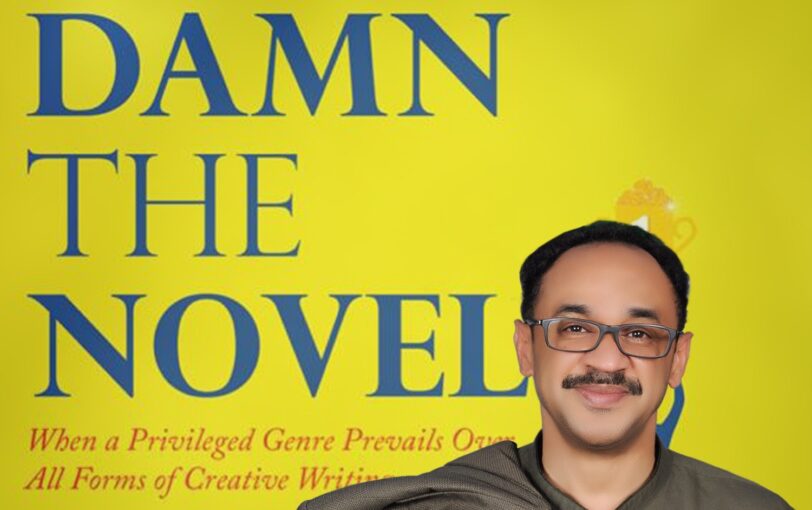
In a series of forty-five short essays that constitute his book translated into English under the title “Damn the Novel: When a Privileged Genre Prevails Over All Forms of Creative Writing,” Sudanese-born poet and essayist Amr Muneer Dahab denounces the privilege granted to the novel, the literary genre that is treated by publishers—and viewed by the public—as superior to all others and is virtually guaranteed marketability and profitability, to the detriment of others.
In this series of posts, the prolific author shares excerpts from the book.

This week: Chapter 34
Between the Lies of Novelists and the Lies of Poets
“So when the poet owns deep insightful ideas without him knowing where they came from or their effects, the philosopher who can find himself in the same ideas only after a long meditation wonders in surprise: Who inspired this bedlamite with this abundant wisdom?”
Andrew Bennett in his book The Author quoted the above idea and words from the French writer Denis Diderot who, according to Bennett, summarizes through the above words “with ultimate dexterity the poet’s ignorance of his work.” All of this comes in the context of discussing theories related to literature writing and the role of the author in the writing process. It is worth noting that philosophers are not the only party mocking poets (according to Diderot’s explanation), but they are joined by—perhaps those actually formulating explanations and theoretical grounds—a very considerable assemblage of critics.
In the same context, Bennett adds a quotation of Percy Bysshe Shelley defending poetry in his essay “A Defence of Poetry”: “Poetry is the centre and the surrounding of knowledge . . . it does not submit to the powers of mind nor does it necessarily relate to the will and consciousness . . . and poets are truthfully the most amazed ones (by their own work) and they are bestowed with uniquely incomprehensible inspiration which they translate to perceivable/comprehensible artful words.”
All of that was a comparison between the poet and other writers, basically philosophers and thinkers; but not novelists in specific, a literary title that had not yet been established and spread as a concept. It was specifically back to the beginning of the controversy about the concept of literary authorship, around the eighteenth century, as Bennett stated in his book. The debate had its roots in an ancient controversy going back to Socrates and Plato.
In The Author, Bennett also inserted another quote by Plato from his dialogue Ion, when he states the words of Socrates: “The poets themselves do not pronounce these verses. . . . It is God himself who is talking to us through them.” Bennett then comments on this statement: “This meaning-loaded description presents the poet as inspired by heavens, but he is for the same reason insane and ignorant, the fact that can be tracked and applied through the literary tradition to our contemporary history (of arts and literature). It seems that this description goes in two directions: first, it pushes the poet and portrays him as a marginalized person culturally and politically, culturally empty, ignorant and even insane. Second, the description shows the poet in some ovation as distinct from the rest, communicating with non-human supreme source(s) of wisdom, and disturbed with inspiration from God, strange in his society, but for all these reasons he can judge himself.”
As for Plato himself, his decision to expel poets from his Republic is well known, and perhaps is the oldest, most famous, and worthiest of note, preceding everyone at that level of dealing with the strange idea and being brave/daring in that context. Plato explains his decision because of a simple and direct reason that poets are lying, and by briefly quoting Plato’s opinion from Bennett, “histrionic poetry is unacceptable, because it distorts the minds of its audience(s).” The funniest here is Plato’s argument that a real bed is merely a representation of the idea of bed, its sample, or form, and that “a picture of a bed or a poem about a bed is merely a representation of the former representation, and likewise the poet is twice away from truth/reality.”
I would like to ask the readers for their pardon here for further quoting before we get to our whole point, which is the comparison among poetry, the novel, and the essay at the level of lying, whether in the way Plato discussed (with discontent) or in the way other people (pleasantly) expressed. Bennett continued his quotes of Plato: “The poet establishes a corrupt government system in the mind of people, through which the irrational side is magnified within its members . . . by creating invented images. . . . And it is tremendously far from the truth . . . poetry has a frightening capacity to distort people, even the good ones among them.”
Then Bennett comments on Plato’s words: “Plato’s expulsion of poets from his virtuous city, just as his portrayal of them or the epic narrators in his book Ion as inspirational but also mindless people, has had a fervent, albeit controversial, impact on the concepts of authorship in the following European literary tradition, and on issues such as the author’s sense (or lack) of responsibility, his moral sense or otherwise, his ability or inability to reveal the truth, seriousness or triviality of the tool he deploys, and his social/political attitudes.”
We have now arrived at our bottom line, and we have presented the issue through many phases, sometimes different and sometimes similar in more than one place. The accusation that poetry and the poet is lying can be applied ten times wider on the novel and the novelist at the moral level. The novelist, through Plato’s expression, is the founder of a government system who spreads extreme corruption in the minds of people by exaggerating the irrational side and creating imaginary (false) images. And, to further borrow from the great philosopher’s sayings, it can be said that the novel has a horrifying ability to destroy good people.
For the purposes of argument, let’s validate the moral influence of both poetry and narrative fiction from the “Platonic” perspective. And so from the same perspective, the essay genre should be glorified on an equal basis with philosophy itself because the essay does not rely on lying primarily. But still here, I would like to use a little dodging eloquence to account for the truth, and I hope that this logic may be permitted. So, the truth is that the essay can, as we have repeatedly pointed out, go along with the poem and the novel side by side, if provoked, in terms of its hidden technical abilities in the arts of description and narration.
As such, it can be said that the essay is “honest in nature” at the moral level, and in turn can be as aesthetically pleasing with lying as needed/demanded by (the) art, and this can be likened to the self-important reflection of many people with regard to exposing their vast experiences in life, seeing that they claim that they are able to be courteous with the polite people, while having enough effrontery to deal rudely with the impertinent people. This actually is the grace of the essay at the ethical level, which could please a philosopher like Plato, while persisting, at the same time, in its seduction to help those who love to fly in the worlds of fiction/lying spread their wings. In depth, it is adorned with the ability to combine two contradictions that are, most of the time, out of the reach of both poetry and narrative fiction.


Soumanou Salifou (administrator)
Soumanou is the Founder, Publisher, and CEO of The African Maganize, which is available both in print and online. Pick up a copy today!