

“Damn the Novel!” An author’s cry against a privileged genre
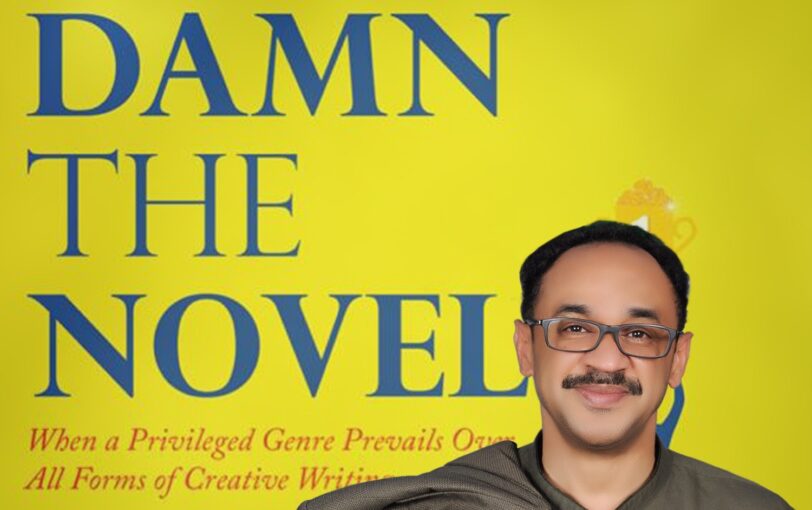
In a series of forty-five short essays that constitute his book translated into English under the title “Damn the Novel: When a Privileged Genre Prevails Over All Forms of Creative Writing,” Sudanese-born poet and essayist Amr Muneer Dahab denounces the privilege granted to the novel, the literary genre that is treated by publishers—and viewed by the public—as superior to all others and is virtually guaranteed marketability and profitability, to the detriment of others.
In this series of posts, the prolific author shares excerpts from the book.

This week: Chapter 33
The Poetry Lover Novelist and the Novel Lover Poet
Apparently, there is much in common between Tayeb Salih and Mahmoud Darwish despite the fact that they both write different literary genres while being subject to comparatively distinctive environments. It is a commonly held fact that there are differences between novel and verse. As for the childhood and youth of the two writers, both of them grew up in the countryside in totally Arabic-oriented environments. I deliberately mentioned Arabic in the second place here to show the differences between them. Because Arabic circumstances in the village where Tayeb Salih was brought up is mixed with African aspects as manifesting in the Sudanese environment; while the origin of Mahmoud Darwish near the Palestinian Galilee (whether Barwa or Jadeidi-Makr) retained the pure Arabic Oriental Levantine aspects, even though the origins of the place extends to civilizations prior to the Arabization process that following the entry of Islamic civilization to the region.
The two great men of letters, as far as I can trust my reading from a distance, share a sincerity and devotion toward the literary art they have committed themselves to, and to the cause of literature and art in general, and that is the most important in what follows.
Tayeb Saleh and Mahmoud Darwish are among the finest contemporary examples in Arabic literature of the “deep reconciliation” between literary genres—and I hope the expression in quotations marks is acceptable. The most beautiful of these reconciliations, which allowed us to describe it as deep/subtle, is that both writers love another literary genre a lot without having practiced it, i.e., as a recipient, not a producer. Thus, that reconciliation between literary genres can be described as instances of serenity and depth as well, on both their parts.
Darwish pointed out in a television interview that he would have wanted to be a story writer if he had not been a poet. I was actually surprised by this simplicity of expression when I first noticed (or perhaps before) my concern with what a writer may positively (or even negatively) feel toward a genre he does not practice, considering my attitude at the time toward genres other than classical Arabic poetry, which I considered to be the origin of all sorts of writing. But of course I was not “aggressive” to other forms of literature in what can be described as blatant hostility, but sufficing only with giving them “the negligence” they “deserve.”
I liked that smart note made by Darwish about a quarter of a century ago even though he was not from the Arabic poetry school I hailed from. But the statement was, after all, the first of my attentive remarks, which took a long time before I realized the value or pleasure of summoning them to mind, such statements that can adorn literary genres with affinity and affection rather than adversity, avoidance, or caution.
I am indebted to Darwish for that. After that, when I started to deeply meditate on our Arabic literary genres in specific and their close/far relations with writers, my attention was noticeably attracted to the fact the man did not rush (quoting Nizar Qabbani in his famous allusions) to write a story or novel, but he was satisfied with enjoying reading narratives. Besides, Darwish did not show any embarrassment in confessing that he was hoping to write them when he answered a very traditional question: If you had not been a poet, what would you have liked to be?
So when Darwish writes nonpoetry, he makes “prose” accommodate the creativity he brings, being satisfied, along with his critics, with that sublime and elegant title (writing prose), and is far from resorting to the transient temptations of the novel and the story. And here, it is needless to say, but only as a reminder, that the literary genre model of prose arts involved here is the essay.
I will not say here “in contrast to Mahmoud Darwish,” but I will use the expression “in parallel,” with that example of reconciliation with the self as a start, then with the genres that are different from the practiced one. The approach/stance of Tayeb Salih is the same (i.e., similar to Darwish’s stance) according to the order of my discovery (to both writers’ stances), or perhaps according to a reversed order referring to birth date and the same experience of reconciliation in the stance (toward appreciating another genre) of the two great writers.
I believe that if Tayeb Salih is characterized by the most important trait in this context—concerning avoiding literary “haste” in experiencing other genres that he liked and the most popular ones at the time just for the sake of experiencing them—he was most daring in “proceeding with” the other genre that pleased him in terms of aesthetic taste and professional criticism. Indeed, his professional criticism was acknowledged by writers and critics alike, regardless of the fact that most of them are concerned more with mentioning the writers in fields that are more widely popular.
However, Dr. Hassan Abbashar Al-Tayeb stated on the cover of The Introductions of Tayeb Salih (Mokadimaat Tayeb Salih), a book published by Dar Riyad Al Rayes: “In expressing his appreciation and valuing the creative introduction (Tayeb Salih’s) which held the forefront pages of the collection ‘Ghabat Al-Abnos,’ our acknowledged scholar, Dr. Ihsan Abbas told me: That’s how poetry criticism must be. This introduction is worthy of being an example in our subject. If it was all up to me, I would make it a course of literary criticism in all classes of Arabic for university students across all Arab countries.” Through his appreciation of the creative novelist and describing him as a unique critic of classical Arabic poetry, Ihsan Abbas turns a blind eye to our accusation.
And if the introduction of Salah Ahmed Ibrahim’s collection Ghabat Al-Abnos has in fact given that eulogy by a great critic such as Ihsan Abbas, the essays of Tayeb Salih that are collected in a book published also by Dar Riyad Al Rayes with the title In the Company of Al-Mutanabi and His Companions (Fi Sohbat Almotanabbi wa Rifaqih) deserve double eulogy as being deep thoughts on criticism of Arabic poetry, revealing the man’s extensive encyclopedic readings, broad literary insight, and a very sharp critic spirit. He is actually a sharp critic because he does inspect his subject matters with an eagle eye, soaring high to bear down upon his target with full attention to the surrounding details, and at the same time embraces his topics passionately and with careful scrutiny.
Indeed, our literary arena is in great need of the culture of respect for and appreciation of different literary genres in the manner of Tayeb Salih and Mahmoud Darwish, the manner that can be described as “the culture of mutual respect/love despite creativity-related divergences.”


Soumanou Salifou (administrator)
Soumanou is the Founder, Publisher, and CEO of The African Maganize, which is available both in print and online. Pick up a copy today!