

“Damn the Novel!” An author’s cry against a privileged genre
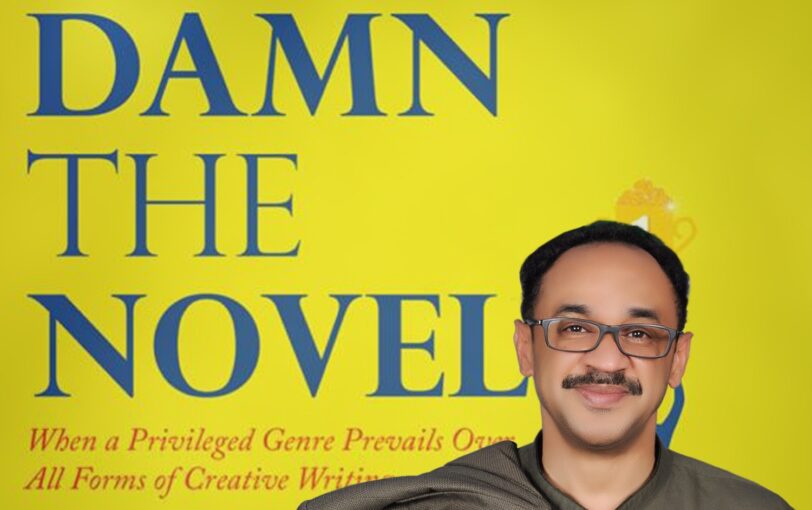
In a series of forty-five short essays that constitute his book translated into English under the title “Damn the Novel: When a Privileged Genre Prevails Over All Forms of Creative Writing,” Sudanese-born poet and essayist Amr Muneer Dahab denounces the privilege granted to the novel, the literary genre that is treated by publishers—and viewed by the public—as superior to all others and is virtually guaranteed marketability and profitability, to the detriment of others.
In this series of posts, the prolific author shares excerpts from the book.

This week: Chapter 26
No Market for the Short Story
“But I don’t want to talk about Jonathan Culler and the approach of his book (Structuralist Poetics) in this context as I have already dealt with it in another distinctive area. My intention here is to draw attention to the first paragraphs that Culler started the sixth chapter of his book with; which I translated carefully (the paragraphs) to signal another opinion describing the era we are living in as the Era of the novel. And we can expand the description to make it the ‘era of narration’ to include the short story for which one of its writers (Alice Munro) won Nobel Prize in 2013. So she rehabilitated the short story genre which was not absent during the shifts throughout the era of the novel and its different versions that involve narration, namely cinema and soap operas. . . . So we can say that the era of narration is the era when poetry forfeited its traditional throne, after having been the most sublime literary genre for ages, to struggle in an unfair (to-be-or- not-be) war.”
Thus the Egyptian critic Gaber Asfour retreated from his campaign of “the Era of the Novel,” which is now widespread after it surpassed all the expectations of Arab contemporary literary audience(s). He actually (and in disguise) converted to the notion to “the Era of Narration” as discussed in his book Narration in the Current Era, which was released fifteen years after his book The Era of the Novel. It is not weird or inappropriate for a writer to question his stand toward a notion/idea or to reshape it to respond to new perspectives that might arise later. However, in this very context, we have two problems: The first one is that “the Era of the Novel” was unjust to all literary genres, not only poetry. When Asfour wanted to reconsider it, he engaged more players to the unfair team including the short story and perhaps more narrative visual arts. That of course was not against verse alone but against all literary genres, like the essay with all its different types. The second problem lies in the fact that the first dictum started from a weird idea manifested in the results of Nobel Prize for literature, which novelists have dominated during the last decades. Updating the title of this era to “the Era of Narration” is also motivated by Western echoes, which Gaber Asfour plainly approached in his quote above. That odd influential echo is actually still holding its seat in the temple of the damned Nobel Prize. I am cursing the Nobel Prize for being the only literary background that has been regarded by Arabs as almost the only cultural/literary standard.
In the introduction to Narration in the Current Era, Gaber Asfour said: “Considering these new ideas, I didn’t give up my belief that we are living in the novel’s era. Rather, I opened new horizons to a new era of storytelling or narration, if we want to be idiomatically precise.” He actually does not idiomatically term the expressions, but he goes toward more idiomatic generalization in attempt to keep his prophecy safe from any investigation. He did that through mobilizing more supporters by assuring more alliances, which military tactics/strategies necessitate in the midst of the battle, so that there will be no issue afterward with confronting (with relieved conscience) the supporters of other literary genres, specifically poetry, at least concerning the battle’s title.
In one of his essays in the Egyptian magazine Al-Ahram, on December 13, 2004, Asfour confirmed that the era of the novel did not start with the novel Zaynab in the twentieth century “as many critics stated stemming from what Yahya Haqqi wrote during the dawn of the Egyptian story, which ultimately turned out to be the dawn of the Arabic story. The era of the Arabic novel is an ongoing process starting when the fundamental conditions of modernity/urbanization are fulfilled to incorporate all diverse languages and races and, consequently, reinforces a class struggle in which the middle class rise promisingly,” Asfour wrote. Then he said, “And this means that the history of the Arabic novel goes back to the second half of the nineteenth century, when historical circumstances—social, political, economic and cultural—were vital for ushering in narrative fiction (novel) as an independent literary genre. That occurred in parallel with the waves of positive values enhanced by changes that had taken place during the eighteenth century, as Peter Gran confirmed in his book Islamic Roots of Capitalism: Egypt, 1760–1840.”
There will be no serious problem, at least for me, when the issue is about the real start of the novel’s era despite the fact that the dispute may have existed for more than fifty years with the contemporary Arabic novel, as we saw in the above quote by Gaber Asfour. Furthermore, a number of scholars, especially those who are obsessed with the roots of Arabic culture, believe that the inception of the Arabic novel was with Ibn al-Muqaffa, and Al-Jahiz in Kalila wa Dimna and Al-Bukhala respectively. Besides, in a more realistic way, (perhaps) they may even consider Ibn Tufayl’s Ḥayy Ibn Yaqzan as a pioneering work in this respect. So, there will be no problem investigating the first straw in the nest of Arabic narrative fiction. But it is not that easy, or that wise, to claim we are living in the almost absolute era of the Arabic novel and that all that is coming (in terms of historical literary process) is mere periods dominated by narration. I do not hold this view for two reasons: The first reason, as some supporters may agree with me, consists of the less friendly feelings I have toward the novelistic genre (and narrative literature as a whole) than the feelings (of esteem) I have for the other genres such as the essay and poetry. The second reason is that I think prophecies (literary ones and other) are more applicable to fortune-tellers than to critics and academic scholars. Literature will be of no use if a given critic confirms victory/validity of a genre at the expense of another genre, even if that critic purports that he bases his conception on neutral readings of literature, history, politics, sociology, and many other fields of human knowledge.
In the book Why We Write, the African American writer Terry McMillan says: “I moved to New York and joined Harlem Writers Guild, something like EWU Library, but it was for black-skinned people. I read the story of ‘Mama, Make Another Step’ for them. . . . When I finished, the novelist Doris Jean Austin told me: this is not a short story darling, it’s a novel. And everybody nodded. I did not actually know that there was no market for short stories. But they did. By the end of that meeting, I had already written my introductory chapter for my first novel ever, Mama.” This incident was in the mideighties in the United States, the source of every possible contemporary “fashion” in writing (and in everything?). And after more than a quarter century later, I do not think that significant change has occurred in the U.S. concerning the market for the short story basically being dominated by long narrative fiction (the novel). Therefore, the retraction of Gaber Asfour by changing the expression “the Era of the Novel” into “the Era of Narration” was probably a retraction for the sake of precaution dictated by some transient (?) events in the market of literature, like when a short story writer was awarded the Nobel Prize.
Most likely, the situation for short story writers seems more dire than the situation for poets. The short story may, with a small alteration, become a novel, as we saw in the example of Terry McMillan. But not all writers of the short story can (or want to) make that alteration. Seeing that what is born from the womb of the art you are practicing is surpassing you to the horizons of glory is sure to provoke your ire, especially when the claim of literary supremacy is based on quality, not quantity/size. I claim here that it is possible, with some leniency in judgment, to describe the discrepancy between the short story and the novel as basically a matter of difference in quantity/size between the two narrative genres.
The matter then, as we have seen through the critics’ comments and the experience of writers, is still related to the nature of the literary “trend,” the spread of which is caused by many factors. These factors, when considered, seem to be similar to the motives that thrust any type of “fashion” into markets without considering their value as marketed products over others in the stores (markets) of literature and other stores in the daily life of consumers/audiences.


Soumanou Salifou (administrator)
Soumanou is the Founder, Publisher, and CEO of The African Maganize, which is available both in print and online. Pick up a copy today!