

“Damn the Novel!” An author’s cry against a privileged genre
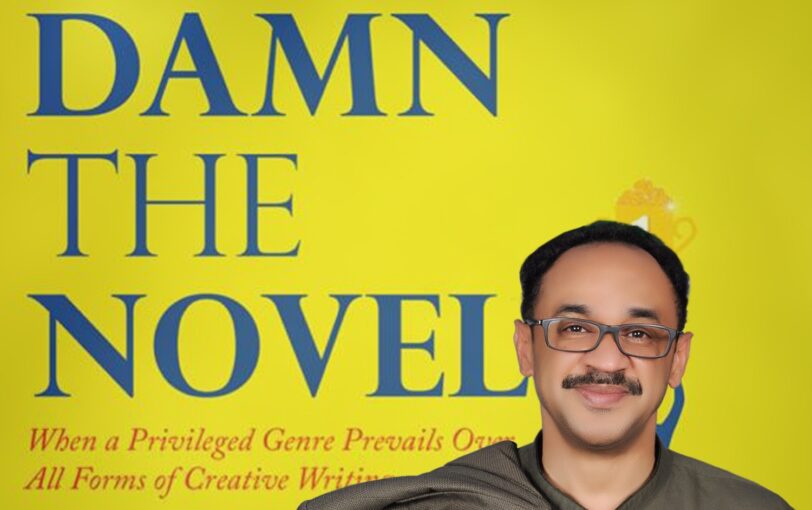
In a series of forty-five short essays that constitute his book translated into English under the title “Damn the Novel: When a Privileged Genre Prevails Over All Forms of Creative Writing,” Sudanese-born poet and essayist Amr Muneer Dahab denounces the privilege granted to the novel, the literary genre that is treated by publishers—and viewed by the public—as superior to all others and is virtually guaranteed marketability and profitability, to the detriment of others.
In this series of posts, the prolific author shares excerpts from the book.

This week:
Chapter 24
Just Come in! The Gate of the Novel Is Wide Open for Sin
We previously mentioned that the route to composing a successful (widespread) novel is guaranteed through tackling contentious issues (taboos, for example). That swift spread will be attained through writing about all that is arousing, preferably sexual relations that take place outside their legal and social norms that regulate life within the relevant society. When sex outside the conventional institutions (namely marriage) is not counted as socially, morally, or religiously an odd behavior in a certain society, novelists (males and females) find another shortcut for marketing their novel through writing in the most explicit manner (obscenely?) about the most forbidden sexual affairs, like incest. This way, in the course of having fiction literary work widely spread by means of such acts, the matter seems to be a race to break through societal taboos more than being a race of literary genres (in the sense of aesthetic competition).
Because the race for popularity is apparently not bound by any constraints, there is no deterrent to jumping over two barriers at once. What we mean by jumping over two barriers at once is when a novelist (preferably a female) from a very conservative society writes about incest (for example) as a phenomenon that exists within her society, quoting a true incident with an alteration of names of people and places.
Perhaps it is not a problem when sexual arousal (no matter how obscene) is included in a novel that has a sublime literary value. The battle then will probably be at the margin of the novel as a work of art while, still, considering literary work as an influential tool within societies. Our matter of concern here will be about the artistically humble (aesthetically weak) literary work that gets pushed to the extremes of popularity only thanks to strumming sexual arousal (obscenity?). The latter, of course, is about to become the equalizer (provocative?) model to reach the furthest perspectives of (false) stardom.
Practically, it is impossible to ignore (the fact?) that literary success can only be achieved if the piece of work invades the audiences, and it is important to go one step back to understand what is meant by success. So, if success means that the literary product (narrative fiction) is artistically sublime, popularity will play a minor role in determining to what extent the piece in question will proceed. But if success means the potency of the literary work, and its ability to influence as many people as possible, popularity will then be a great measure of the successfulness of the literary fruit.
However, the issue is much more complex than the simple classification above. The dilemma (crisis) is when the judgment involves an artistically humble piece of work that is popular because of many other reasons, including the support from glamorous critics who believe that literature must break into the dark untouchable corners of human life. So, they do not object and even do not find any harm in popularizing a humble literary work that intrudes into what most prominent writers do not dare to approach.
Again, the matter is more complicated and more ambiguous, even after responding to the above categorization. The problem is that sexuality has become a factor in the popularity of a novel at the expense of another novel that does not include sex as a theme; the comparatively less popular narrative might be of more artistic and literary sublimity (or even uniqueness).
Actually, we are supposing that “novel fashion/trend” goes hand in hand with “sex fashion/trend,” that sex with all its conventional (even though rarely) and forbidden forms is a powerful factor leading to popularity (and consequently to success!). We, on the other hand, do not accuse poetry, either in the modern era or the other eras when it reached the peak of lasciviousness, of the wrongdoings committed by contemporary novels. We do that for the simple reason (at least that’s how we see it) that poetry at that time was not rivaling with any other genre; it was actually competing against itself. Nowadays, the novel is leaning on sexuality so as to gain celebrity over its literary rivals, even among works with the same sublime artistic value. Contemporary, and even traditional, poetry is to a high extent innocent of such (ill) deeds. In fact, poetry’s dominance over Arabs was attributed mainly to artistic factors far away from other temptations such as sex. Besides, when some of the great poets of that time intruded into the forbidden areas of eroticism, they did it in few verses either separately or within one of their valueless/less popular poems. More explicitly, sex (both legal and forbidden) did not used to be a sound factor determining failure or popularity of a poem throughout the history of Arabic poetry, with few exceptions, as with the first poems of the Syrian poet Nizar Qabbani, before he shifted to devote his poems to women issues in general and not sex with woman/sex and woman.
Arabic poetry then remained more self-confident (I hope the expression will be acceptable) than what we saw in the novel. When the novel embraces sex as a “basic instinct” that exists in all fictional work (and sometimes cannot stand without it), we say that the problem does not depend on the genre itself but comes from exploiting sex as a basic instinct instead of many basic instincts that we mentioned previously—namely, fear, revenge, curiosity, and desire for possession.
Under the facts that we have shown above, it became harder for novel lovers to deny that their “beloved” is less confident—that is, because it counts on “external” factors (sex as a theme in one novel and not necessarily in every novel), rather than its own literary techniques and features, to reach audiences, compared to Arabic poetry throughout its different epochs.
In the West, sex is dealt with in almost every novel because it is a familiar detail in their daily lives being eyed with much directness, explicitness, and intimacy. The issue is different when it comes to our (Arab) societies. That’s why sex in the Arabic novel in many (most?) cases is inserted or improvised. That’s a losing cause unless its advocators count on the potential that the direction of influence is inversed—that is to say, reversing the system of social life where sexual arousing becomes part of the daily life of Arabs. In such a situation, no condemnation will be laid upon novel devotees on condition that, first, they stop popularizing a humble (tacky?) novel just because it breaks through the taboos of the society, and, second, they must be courageous enough to bow before Arabic poetry’s sovereignty, which managed to obsess the hearts of Arabs for centuries counting greatly on its self-confidence without any need to hide behind sex or other transient arousals.


Soumanou Salifou (administrator)
Soumanou is the Founder, Publisher, and CEO of The African Maganize, which is available both in print and online. Pick up a copy today!