

“The African Magazine” at twenty-six

Gen. Colin Powell and former Virginia governor Doug Wilder admire the maiden issue of The African at a function honoring then-South Africa’s president, Nelson Mandela, in Washington on Oct. 6, 1994 while founder, Soumanou Salifou (left, with eyes closed) savors the historic moment.
BY SOUMANOU SALIFOU
Before I took advantage of a high-profile, glamorous event held at the Washington, D.C. Sheraton hotel on October 6, 1994 to launch The African Magazine, a publication committed to providing balanced reporting about Africa in the United States while fueling the ongoing efforts to connect Africa and black America, there were no African magazines published in this great nation.
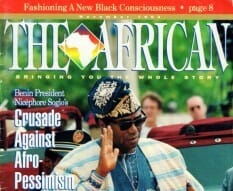
It had been my view since I arrived in the United States as a student in International Relations at the Johns Hopkins University’s School of Advanced International Studies in August 1983—especially after I grew more familiar with the information business upon joining the Voice Of America in 1985 as an international radio broadcaster—that Africa should not be viewed solely through the prism of the many woes that permeate the continent: abject poverty, civil wars, or the short supply of democracy. That view was held by countless Africans, particularly those living outside the continent, some of whom probably intended to create their own news organizations to show the positive side of things back home. But, as the late John H. Johnson, founder and publisher of Ebony magazine, wrote in the special issue commemorating the 50th anniversary of his pioneering magazine, God chose me to lead the way.

Then-U.S. Ambassador to Benin, Ruth A. Davis, during an exclusive interview with Founder/Publisher Soumanou Salifou in her office in Cotonou– Nov. 1994
Before The African came to life, some Americans were familiar with African magazines published outside the United States, but many of them proved enthusiastic about The African and pointed out its significance and relevance, just as Africans did. A review in the Library Journal in 1999 about The African stated, emphatically: “Laudatory and yet critical, The African offers a window into a misunderstood continent, and would make a valued addition to any public or academic institution.” To crown it all, a congratulatory letter from President George W. Bush came to warm our hearts in 2002.

Founder/Publisher Soumanou Salifou with then-President Gnassingbe Eyadema of Togo at the presidential palace in Lome in 2001
My personal debt to President Mandela
The journey started twenty-six years ago in the living room of my townhouse in Springfield, Virginia, at a time when I was the company’s sole employee. Now sitting in my elegant office, it’s with deep emotion that I look back at the uphill journey.
I may have taken the first step and paid the heaviest prices to turn the dream into reality, but I owe a debt of gratitude to countless people. Among them the former president of Benin, Nicéphore Soglo, who believed in my dream and lent extraordinary support; the late president of Togo, Gnassingbe Eyadema; former Benin State Director of Protocol and my brother Lucien Tonoukouin; and my other brothers: Yacouba Fassassi, Mishel Kamara, Mouftaou Alidou, Saturnin Agbota, Bouraima Salifou, and Idrissa Seydou Dia.

President George W. Bush writes to The African
It’s easy to be brought down by negativity, but my staunch belief in the dream was never bent, even at the darkest of hours, by the wickedness of the predators in the African underworld, or the cynicism of the doubters who laughed at my “excessive optimism,” or even the hopelessness of loved ones who felt the train was taking too long to come to the station. I can now say, echoing Ebony‘s founder John H. Johnson, that, after all, “darkness was light enough.”

Founder/Publisher Soumanou Salifou with Cote d’Ivoire’s President Laurent Gbagbo at the presidential palace in 2002

Of all the grand reporting and the exclusive interviews with African heads of state, high-level American officials and prominent figures such as American billionaire Maurice Tempelsman, the following seemingly insignificant letter from a New York high school student named Yussef whose grand-mother is from Africa, struck a special chord in me:
“Me and my classmates had a heated argument the other day because they said that the picture of Abidjan By Night in the July [1996] issue of your magazine is not real, that Africa is just a jungle. I don’t believe so. I’m proud of your magazine.”


Soumanou Salifou (administrator)
Soumanou is the Founder, Publisher, and CEO of The African Maganize, which is available both in print and online. Pick up a copy today!