

President Macron Apologizes for France’s Role in The Rwandan Genocide
BY AISHA SAMUSHA
1959 marked the beginning of a genocide that would leave deep scars in Rwanda until today and for unforeseen time to come. Scars so deep that France’s president Emmanuel Macron issued an apology yesterday, Friday, for the role France owns in the occurrence of the genocide.
The division between the Hutus and Tutsis in Rwanda led to a genocide that is a painful reality difficult to navigate in the current day. In 1959, the Tutsi monarchy was overthrown by the Hutus, which led to a mass fleeing to neighbouring countries. In response, the exiled Tutsi clan formed a rebel group named Rwandan Patriotic Front which invaded Rwanda from 1990 to 1993.
On April 6, 1994, a plane carrying then-Rwandan president Juvénal Habyarimana and Cyprien Ntaryamita, then-former president of Burundi (both from the Hutu clan), was shot down, killing all passengers on board. The extremists from the Hutu clan pointed fingers at the Rwandan Patriotic Front and assigned the responsibility of the death of the two prominent figures. This occurrence was the tipping point of what was already a tense relationship between the two, and a slaughter campaign was launched seeing each side assigned blame. The death toll was astronomical: between 800,000 and ds1,000,000.
The genocide saw husbands killing their wives of the opposing clan and neighbours killing each other. It is believed that even priests played a role by providing shelter and a ‘haven’ only to kill the other. The Hutus set up roadblocks where they easily identified the Tutsis, knowing that identification at that time included ethnicity, and upon identification, death was the penalty.
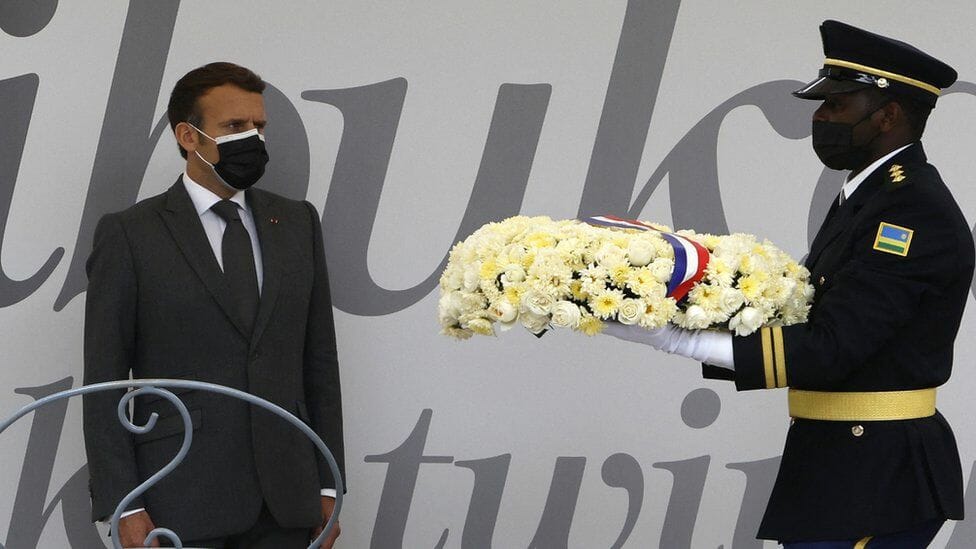
France’s president Emmanuel Macron visited Rwanda yesterday, May 27 and issued an apology to Rwanda as this marked the genocide memorial in Kigali.
“France has a role, a history and a political responsibility in Rwanda. It has a duty: That of looking history in the face and recognizing the suffering that is inflicted on the Rwandan people by favouring silence over the examination of truth for too long.”
He goes on to say that when the genocide started,
“the international community took close to three months, three interminable months, before reacting and we, all of us, abandoned hundreds of thousands of victims.”
France’s failures contributed to “27 years of bitter distance” between the two countries, the French president also said, adding that “Apologize is not the appropriate term, and I cannot grant forgiveness.”
Rwandan citizens, generally speaking, feel betrayed by the ‘vague admission and lack of apology.’’ Daily Sabah Reporting Platform quotes a vendor who states, “I wish he could ask forgiveness for what France did during 1994.” Sentiments such as those of the quoted vendor may be anchored in the fact that the French were allies of the Hutu government during the genocide period. The French evacuated their citizens and created ‘safe zones’ for the remaining people but did not do much beyond that. Rwanda’s government as well as genocide survivor organizations to this day believe that France was directly involved in the training of militias and the troops that led the genocide—but that has not been proven.
Although Rwandans expected an apology, President Macron clarifies that ‘’France was not an accomplice.’’ He simply acknowledges that they should have done more and not kept silent. He goes on to say, “Only those who went through that night can perhaps forgive, and in doing so give the gift of forgiveness.’’
Both President Kagame and President Macron agreed to move forward by turning a new page and investing in the future.
Rwandan President Paul Kagame responded to this as “an act of tremendous courage.” He states, “This visit is about the future, not the past.”
The Rwandan genocide has been showcased in multiple programs. Films on the genocide include 100 Days, Hotel Rwanda, Shooting Dogs, Sometimes in April, A Sunday in Kigali, and Shake Hands with the Devil. Documentaries include BBC Panorama; Journey into the darkness, and Culture of Murder.
This visit to Rwanda by the French president coincides with the month where the continent celebrates Africa Day. The unifying of countries and independence from the colonial rule are the celebrations of the day, though painful histories such as the genocide remain difficult to navigate.


Soumanou Salifou (administrator)
Soumanou is the Founder, Publisher, and CEO of The African Maganize, which is available both in print and online. Pick up a copy today!