

“Damn the Novel!” An author’s cry against a privileged genre
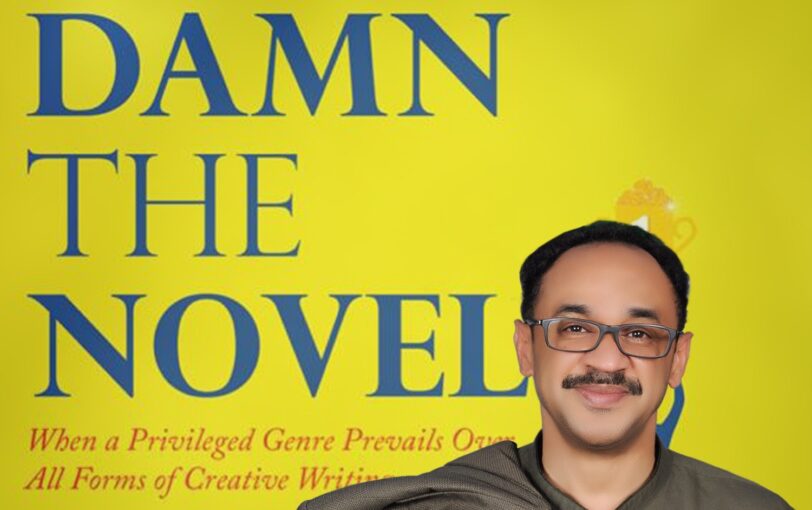
In a series of forty-five short essays that constitute his book translated into English under the title “Damn the Novel: When a Privileged Genre Prevails Over All Forms of Creative Writing,” Sudanese-born poet and essayist Amr Muneer Dahab denounces the privilege granted to the novel, the literary genre that is treated by publishers—and viewed by the public—as superior to all others and is virtually guaranteed marketability and profitability, to the detriment of others.
In this series of posts, the prolific author shares excerpts from the book.

This week: Chapter 29
The Literal Followers of Western Literature
Our problem in the Arab world is keeping track of the steps of the West on all known roads. I am not certain here who is worthy of being applauded: “Is it the quickest one to imitate others or the tardiest?” I have mentioned previously in more than one place that some had denied the fact that Arabs were late even in knowing that they would like to be the subject of imitation. The sexual revolution in the West exploded in the sixties, and it did not enter the Arab world till after a full decade. As usual, it did not break through all people’s lives, as happened in the West, but skirmished with Arab life through different media and cultural mediums. If it is easy to understand why imitation is so late considering sensitive and complex issues for Arabs like the sexual revolution, it is worth noticing that the situation/stance of Arabs in imitating (the West) is not much better (i.e., it comes late also) when it comes to other social, psychological, and doctrinal fields with less sensitivity/complex nature.
It is not fair to have imitation as an accusation of Arabs only. All Third World countries imitate the West in one way or another. As for the Second World, most of its countries have some original creativity. When they imitate the West, they actually do it to catch up with the first’s advancement in a certain craft in preparation to surpass them while heading to new horizons of innovation. But the most appealing point here is that Western countries (namely the U.S. and Europe) are also imitating each other. It is righteous for the West to claim in front of the rest of the world (I hope the expression will be acceptable) that they are one harmonious creative “mass.” It is a claim that won’t have any considerable opposition, except when the battling is between two western countries, away from the rest of the world who will only watch, comment, and follow what the West’s pure dispute may come out with.
Our imitation in the Arab scene is unable to come up with any parallel creative work or unique product in any field (I hope the absolute generalization is true here). We are often skillful in imitating in certain fields, but we stand there, just skillful in imitating, to keep wandering afterward in the vicious circle of the imitated work. And by means of modern tech, which has filled the entire world with its grace, we are no more than ten years behind the West in receiving a social or scientific invention. Maybe we should be more preservative when speaking of importing intellectual doctrines, as we are late when it comes to the deep understanding and digestion of such doctrines, and not only importing them to show off.
In the book Questions of Criticism by Jihad Fadel, thirty years ago, Jabra Ibrahim Jabra bemoaned the situation of Arabs in what resembled the subject matter we are dealing with here; but Jabra’s disparagement was about literary criticism in specific: “Arab critics now are under the shock of cultural criticism. I start feeling this shock as a man who contributed, in my manner and in the manner of those who taught me, to the field of criticism during the last thirty years. This shock caused many of the critics and scholars a sort of stupor; they cannot understand what is going on in criticism’s arena in France because of its having many names, many methods and many approaches, nor can they be satisfied with what they had taken from their teachers about approaches and methods of criticism. Therefore, we, or some of us, were obliged to say that there is no criticism (in our Arab world) because our critics are no more skillful in the French way to apply it on Arabic literature, while refusing to deploy the traditional way which they could have developed in connection with the special genius traits of the Arabic language, and with the Arab unique legacy. So, everyone fell between the two sides of the grinder.”
Jabra continued his statement: “It seems to me that the issue became as if we are now being grinded between the two parts of the grinder. And the skillful one is who can get out of this dilemma through confronting the creative work being spread now in the Arab world in some way. If there is no such critical approach to this work, we will keep turning in the French modern criticism whirlpool which is not that much accepted worldwide as some may think. It is indeed still in the forms of schools represented by its individuals. When you now mention Roland Barthes, Foucault, Derrida or Todorov, or others, we can only find those who always repeat that this is the method of Mr. so and Mr. so. This means that this method is in a personal way linked to the critic himself and not as a general method that can be made as a constitution or theory acceptable the way theories of Plato or Aristotle in matters of thought were accepted, for example.”
The situation now is not very different after nearly a quarter of a century, either with criticism or other areas of thought. And what is most important to be considered from the words of the artful critic is that Arabs could have read their creative work by means of deriving from the ancient methods of Arabic criticism. And it is a favor worthy of consideration and whose return, after patiently spending time and effort on, would be more worthwhile than the expectations of the outcome of the pursuit of French critics’ ideas/thoughts every time.
Nevertheless, Arabs not only no longer turn a blind eye to being stung in the same way twice, but also have become professional in the race to follow the West in different aspects, even when it comes to the idea of imitation in general.
With the novel, I will not say that the situation is only similar, but it is, as we can see, about to reach its peak concerning keeping track of the western literary and intellectual destination. And the fact that the imitation target this time is Europe in general, and not France specifically, changes nothing. That’s because the European novel, as some see it, has been inspiring and dominating, even if I see that the U.S. is more dominating and inspiring in terms of regulating narrative fiction as the most sublime genre in a given era. That, of course, happens through spawning exceptional novelists or by the skill of making everyone appear more pompous in the international scene with their sense of creativity via the great American media machine. Thus, Uncle Sam has apparently become, with the novel and otherwise, the most attractive destination for the imitating Arab creators (and honestly also for non-Arabs).
In the end, I would like to go back to Questions of Criticism and quote Jihad Fadel: “Unfortunately, things are given (a new) life here (in the Arab World) after their lives are over somewhere else,” and Ibrahim Jabra’s reply would fit as, “And that’s the catastrophe!”


Soumanou Salifou (administrator)
Soumanou is the Founder, Publisher, and CEO of The African Maganize, which is available both in print and online. Pick up a copy today!