

“Damn the Novel!” An author’s cry against a privileged genre
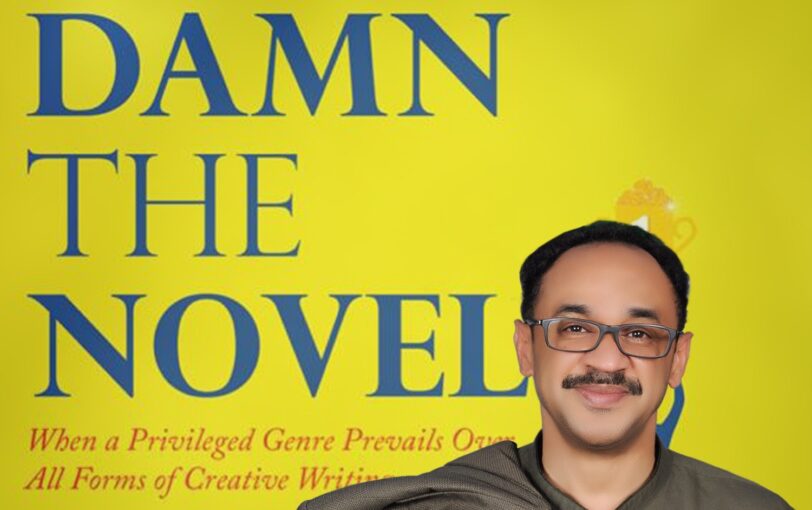
In a series of forty-five short essays that constitute his book translated into English under the title “Damn the Novel: When a Privileged Genre Prevails Over All Forms of Creative Writing,” Sudanese-born poet and essayist Amr Muneer Dahab denounces the privilege granted to the novel, the literary genre that is treated by publishers—and viewed by the public—as superior to all others and is virtually guaranteed marketability and profitability, to the detriment of others.
In this series of posts, the prolific author shares excerpts from the book.

This week: Chapter 44 I Can Write This Way
“When I went to the college, I had had a good literary background. At the University of Bogota I started making friends to whom I am grateful for introducing me to a bunch of modern writers. One night, a friend of mine lent me a book of Franz Kafka. I went back to my room and I started reading ‘The Metamorphosis.’ I was shocked reading the first line. I was likely to fall from my bed. I was surprisingly amazed: ‘as Gregor Samsa awoke one morning from uneasy dreams he found himself transformed in his bed into a gigantic insect-like creature.’ When I read this line I thought for a moment and said: I don’t know someone who was permitted to write this way. If I had known, I would have started writing long ago.”
Thus, a well-known writer of the twentieth century described the way he discovered a role model writer—a path to follow in his literary pursuit/career. It might be surprising for many that Gabriel Garcia Marquez is the writer who said this. The majority of people think that writers are born with that skill/talent of writing which they must hold as an unenviable fate/burden for the rest of their lives.
In another part of the book Date a Girl Who Loves Writing, which is where the Garcia Marquez quote is from, the Japanese novelist Haruki Murakami presented a similar experience: “I can remember the moment exactly, it was half past one in the first days of April 1978. I was in Ginkgo Stadium watching baseball. The stadium was close to my flat. I was a fan of Yakut Swallows. It was a nice day of spring with a clear sky and warm air. When the match was being played, I got the idea: ‘You know? I have to write a novel.’ I still remember the open sky and me sitting on the grass, and the sound of the ball and the bat. Something fell from the sky, whatever it was, I received it for real.”
Murakami proceeds: “I didn’t have the motivation to be a novelist. I just had a deep desire to write a novel. I did not know what to write about. I had just the faith that I can write something convincing. When I sat at my desk for the first time, I realized that I did not even have a suitable pen. I went to the shop of Kinokuniya in Shinjuku; I bought papers and a pen with $5. It was a small budget to start with. During that fall, I end up writing a book of 200 pages. I didn’t know what to do with it. I sent it to Gunzo literary magazine to participate in a competition for new writers; I sent it without keeping a copy for myself. I didn’t care if I didn’t win. Thus the only copy of my first novel disappeared.”
Before elaborating on the statement of Haruki Murakami, due to its importance in this context, I have to stop at the point about sending the literary work without keeping a copy for his own. Such deed is considered as madness for writers, but that happened with Mr. Murakami and I know many prominent creators who don’t remember where they put a poem they had written, and others who just ignore and look to start something new, wondering what you mean by asking about their last works.
So writing, as we mentioned before, cannot reach the state of holiness as might be believed. Murakami keeps telling his story with writing: “The next spring, I received a call from the editor of Gunzo magazine informing me that my novel reached the short list for the award. At that time, I forgot that I participated in such competition. I was busy with many things, even though, my novel was nominated for the award. It was published under the title of Hear the Wind Sing. The novel was received with a great amount of admiration. Without realizing what was going on, I found myself among the new generation of Japanese writers. I was surprised along with my family.”
No writer is born being sure about his fate (literary career), even if that happens with some writers. It is as if someone says that from childhood he was longing to be an ear, nose, and throat specialist. That cannot be considered a healthy situation, because it hides for the person many horizons where he might produce more and more fruitful and special work. Many writers discovered their talent only suddenly before they largely dominated the arena of their expertise with the originality of their creative products; the examples we mentioned above are proofs of that notion.
The interesting point in the case of Garcia Marquez is that he discovered the way he can write, meaning that he could have been a writer but not as the prestigious Garcia Marquez we know if he adopted other styles, or if he didn’t read “The Metamorphosis,” which his friend had lent him.
The most interesting part in Murakami’s statement is that he felt the desire to write just one novel (receiving well the thing that fell on him from the sky). He didn’t have the desire to be a universal novelist. The endeavor for literary fame on the part of a writer or a novelist is legitimate, though it might stop gifted writers from embracing other potential shores of originality and uniqueness in some distant realm in art or in life, too.
It could be obvious from both statements of Garcia Marquez and Murakami that the writer can be surprised by creating something in some way he never imagined, or become talented in a certain literary aspect without prior signs. The most important in this context is that the writer doesn’t stop at the first cry of “I can write this way”; writer is believed to go far beyond the usual when he realizes his talent has noticeably and flourishingly blossomed in the gardens of creativity. He would mute his coming surprises: “Oh, I’ve gone far from my fellow writers,” either as an expression of modesty or shyness, or maybe because the writer has become aware that his talents/creativity needs no confirmation from any (literary or cultural) authority.


Soumanou Salifou (administrator)
Soumanou is the Founder, Publisher, and CEO of The African Maganize, which is available both in print and online. Pick up a copy today!