

WANT TO LIVE WITH 60 CHEETAHS?
Live with them? Come to Love them!
BY JEFFREY FADIMAN, M.A, PH.D, DIP ED. (BRITISH)
Images by Michael Martin and Cameron Kumar
O-o-o-o-h! A White Lion! Aren’t they rare?
The group surged against the wire enclosing the large, male lion. He was indeed white and extremely rare. He was also annoyed when they put their hands through the wire to film him. Slowly, he curled his lip into a snarl, raised his hind leg in the group’s direction and . . . let lion urine fly. (Direct hit!)
And there I stood, supposedly leading these eight tourists into “wild” Africa but watching them get sprayed instead. They laughed it off. It was an admittedly wet example of what they had come here to experience.
These days, “wild” Africa—in the sense of a wilderness experience—is out of reach for tourists that flow into minivans to spot wildlife. These days, most wilderness game runs have gone high tech.
How a Game-run “Really” Works
You rise at dawn, then stagger sleepily to a waiting minivan and join eight others. The van bumps down dirt roads, but never leaves them to explore the bush. The radio crackles, as your driver/guide speaks non-English. “Clients want lions first. Locate please?”
Lions live in prides (families) of two to 16. Prides live in fixed territories, near water. Like people, they stay near their favorite spots, usually where thick bush offers shade. The drivers know just where they are.
The radio crackles frequently, as drivers spot every pride in driving range. We race lionwards—but are blocked by three other minivans moving sl-o-owly towards the same pride. We see it six minutes after leaving the lodge. Nine lions, wow! Only problem: They are all asleep. A big male, six feet from my van, lies on his back, legs splayed, eyes closed.
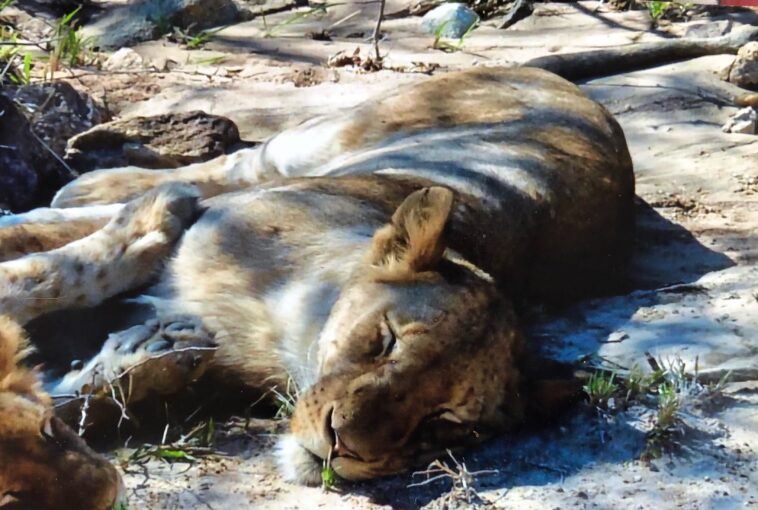
Hey! That’s not what my group came to see. They want a lion that jumps on zebras, and roars. Sorry! Welcome to real wild Africa. Most prides hunt either at dusk or in darkness. Most attacks fail, as the prey streaks off. However, most prides pursue the same animal, wearing it down until they kill. Then, they eat in the darkness. As dawn breaks, they drink, then seek cover, shade and sleep—which is when the minivans appear.
To please the passengers, drivers gun their motors, edging closer to the sleepers. More drivers arrive, as the radio spreads the news. Sometimes, a lion is surrounded by cars. Drivers talk, spouting memorized data that listeners forget. Tourists talk (or shout) as they aim their cameras. Once, I heard a tourist yell at a lion: “get up and kill something.”
Annoyed, they slink deeper into bush where vans can’t follow. I have seen cheetahs give up their normal hunt at dusk, because tourists appear. Now, they hunt around noon, while tourists have lunch.
In fact, even watching lions sleep is enormous fun. Each driver’s goal is to spot Africa’s Big Five (lion, leopard, elephant, rhino, buffalo) before lunch, to maximize tips. Electronics make that easy. However, few consider these micro-organized, high-tech sightings as an entry into wild Africa.
This group liked sighting animals but had come here to live with them. Most came from Silicon Valley. None had seen wildlife outside zoos. For them, “wild” Africa meant interacting with wild animals—feed, stroke, train, play with (babies), and maybe come to love them. Being sprayed with lion urine was just a start. It was a wet way of interacting.
The place they chose was Hoedspruit Endangered Species Centre (HESC), a cheetah breeding point and wildlife sanctuary—both for orphans (whose parents had been poached) and adults who were speared, shot, snared, or poisoned. They accept every species that has been harmed.

Day 1: Handfeeding 60 cheetahs
The first African sunrise is not always welcome to sleepy tourists, especially when dawn finds them wrist-deep in raw hamburger. Nonetheless, 60 cheetahs needed breakfast. Each eats 5.5 pounds of meat, all of which is hand-mixed with nutrients. My group became mixers. Sixty meat-filled bowls later, they hand-fed 60 cheetahs. In HESC, this meant that:
- Tourist opens enclosure, holding bowls. Cheetah snarls.
- Tourist says (or shouts) magic word, “BOO.” Cheetah retreats.
- Tourists put meat on ground. Cheetah advances.
- Facing cheetah, tourist retreats.
- Next enclosure.
After feeding, some cheetahs get to run. HESC provides a cloth “rabbit,” attached to a cable that jerks it electronically across rough ground. Cheetahs can chase at 70 mph (for 400 yards), while the group films.
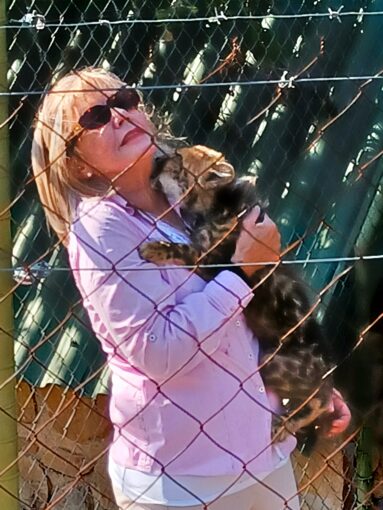
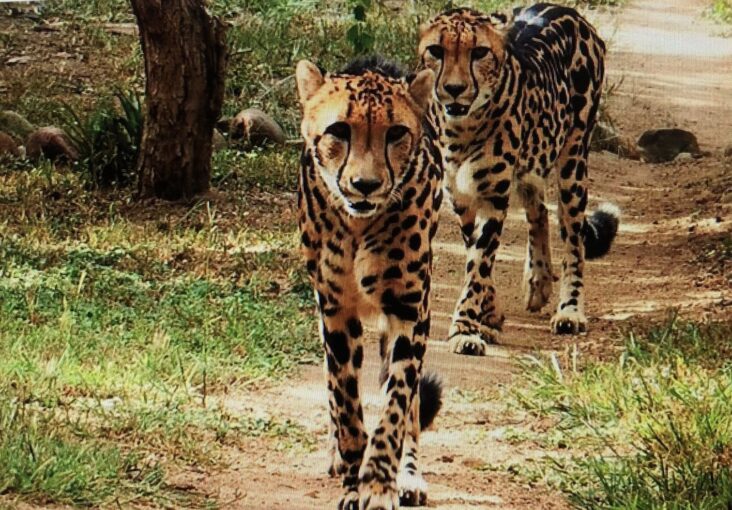
Cheetahs can grow to like humans—perhaps even love them. At age five, Lente Roode, HESC’s founder, was given a one-week-old cheetah cub. It squirmed sleepily into a relationship that lasted 21 years. The cub found a mama; Lente found a career; as a mama to cheetahs.
Lente developed an almost mystical rapport with cheetahs. I have watched her enter an enclosure, then greet its thoroughly wild cheetahs by cooing and stroking their ears. Now, I watched her walk across an enclosure, a huge king cheetah padding behind her. They came to a small hill. Lente went around it; the cheetah went up. On top, he looked down at Lente, walking directly below, and growled. Briefly startled, Lente looked up and blew him a kiss.
She beckoned me into another enclosure, holding cheetah cubs whose mother had stopped giving milk. Instantly, Lente moved out of her house and into their enclosure, bottle feeding them night and day. She hugged one, then—unexpectedly—handed her to me. Stunned, I stroked her behind both ears and then suddenly kissed her nose. She kissed back, thoroughly licking my nose. Frankly, I was thrilled. There is much to be said for interaction.
Day 3: Dining at The Vulture Restaurant
How do tourists “interact” with Africa’s birds of prey—eagles, buzzards, vultures, storks? They start by giving them meat scraps and bones. One morning, the group collected those remnants the cheetahs did not eat, then scattered them around the Centre’s “Vulture Restaurant,” a field covered daily with meat-scraps and bones.
Meat and bones draw birds of prey. Every airborne predator within miles swooped down to gobble. Once, a bird stole from another, starting a mini war that made great filming. Once, a tourist bit into his own meat sandwich. W-h-o-o-m: Something with wings and a beak snatched it out of his hand. (Did that count as interaction?)
Day 5: Breakfast with Elephants
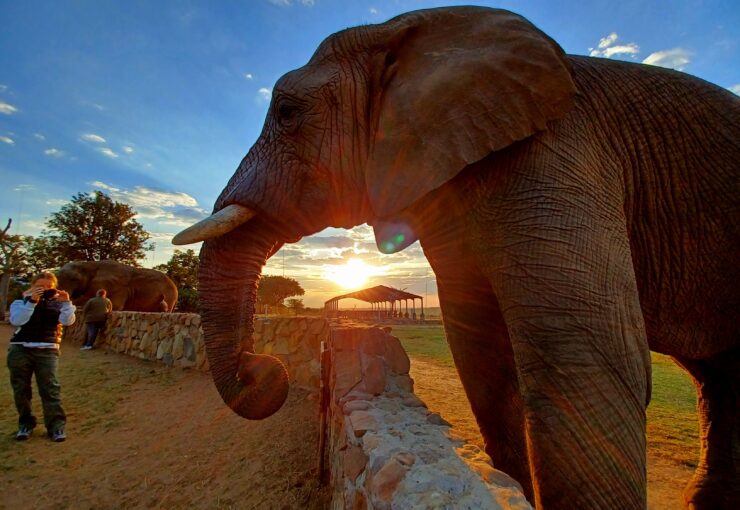
Another dawn was spent with elephants. This herd had been raised in Zimbabwe, where selected tourists enjoyed “breakfast with ele’s.” Four “eles” were staked in a line, a handler by each. Guests then ate breakfast inches beyond their outstretched trunks. However, they could breakfast “with” them by dropping bits of food into those outstretched trunks as they ate. Both sides seemed pleased.
Our group, although denied the breakfast, did feed, stroke, photograph, and film. It is fun to be filmed standing between two elephant tusks, with the trunk up above your head. It is better when an elephant explores you, its trunk ranging quietly along your hair, ears and face—as you stand stock still and semi-scared. Those moments can touch your heart.
Day 7: War in the thorn trees: Giraffes vs Ants
This day started with a “walk about.” The group, led by a guide, entered the bush. The guide’s job: to spot any wild thing that flies, creeps, slithers or even grows as they pass, then explain them. This walk included go-away birds, harmless snakes, poisonous snakes, elephant dung, dung beetles, giraffes and biting ants.
In Africa even insects matter, especially when they need elephants to survive. Everyone spotted the dung beetles; black, fat, and pushing balls of elephant dung.
“Watch the dung,” the guide began. “Fifteen seconds after hitting the ground, it is covered by beetles, each slicing off its share. Shaping their slices into balls, the beetles role them into well-concealed nests. Once nested, they deposit each egg within a micro-dung ball, which the young eat as they mature. “What will happen,” asked the guide, “if every elephant is poached?” Our answer: “Every dung beetle dies as well. In Africa, everything interacts.”
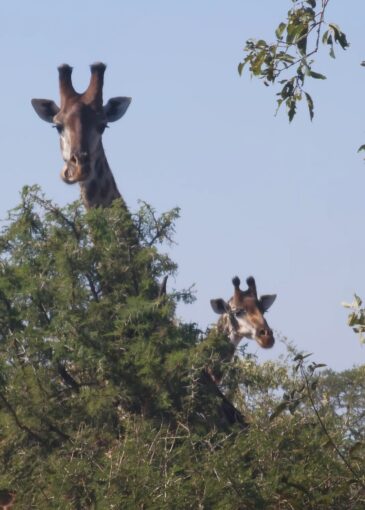
“Now watch the giraffes,“ the guide continued. “They eat thorns off the thorn trees. If they keep eating, they will strip and kill the tree. How does the tree fight back?” No one knew.
“Now, watch the tree,” he concluded. “It suddenly swarmed with ants. They raise their young,” said the guide, “in the thickest part of each thorn.” When a giraffe uses his long, purple tongue to strip the tree of thorns, he shakes the branches. Shaking scares ants. With their tree, thorns, and families in danger, they mass-charge the giraffe’s tongue, racing along every branch to cluster on it and bite.
Several tongue-bites later, the giraffe jerks his head away to find another tree. After several more ant-bites on that tree, he jerks away again. Results: Giraffes survive by devouring a few bites from many trees. The trees survive by nourishing ants. The ants survive, by protecting “their tree” against giraffes. “If poachers kill every giraffe,” the guide concluded, “every thorn tree and ant would die as well. In Africa, all things need each other. How is it in America?”
Day 8: “Gasp! A Snake. Shall We Kill it?”
As we walked, we looked for snakes—hoping not to see one. No luck; we did. Warned by the guide, we stopped well short of a thoroughly poisonous cobra, curled up quietly on a path. “Do we kill it?” someone asked? “No,” laughed the guide. “We learn about it. Watch.”
Gently, he inserted a long stick under the cobra, picked it up, then put it down on sun-warmed dirt. Instantly, it curled to sleep. Next, he poked it with the same stick. This time it reared up, extended its head flaps to look larger, and opened its mouth to strike the stick. The stick was then withdrawn, as we all backed off one pace. The snake then curled up again and slept.
“What did you learn?” asked the guide. He elaborated:
“That it only attacks if attacked,” we replied. “Now you know Africa’s greatest secret,” said the guide. “When Whites first came, they thought every African animal wanted to attack them. So, they shot everything on sight. That was nonsense. Most animals want only to be left alone. When a hippo opens its jaws in the water. . .when an elephant stamps and spreads his ears. . .when a male lion crouches, snarls, expands his mane and lashes his tail. . .these are all mock charges. The message is not “I’m hungry,” but “Go away.”
Day 9: Soccer with kids; dancing with dancers

Every visitor to Africa should interact with Africans. High tech safaris often ignore this option to focus on The Big Five. Thus, Americans spend weeks in Africa without really talking with Africans. Their conversation, too often, consists of “please” and “thanks.”
This group wanted conversation. We went to a primary school. Many tourists visit schools. Sadly, many tour agencies take tour groups to the same school. In consequence, a ritual emerges with each group following a pre-set path:
- Tourists enter classroom. Pupils, used to tourists, stay silent.
- Tourists greet. (“Good morning”)
- Pupils, pre-coached, SHOUT back. (”GOOD MORNING, SIR!”)
- Pupils, pre-coached, sing a song.
- Group applauds, takes pictures, but rarely sings back.
- Pupils, pre-coached, begin five minutes of a lesson.
- Group (bored) quickly applauds, says goodbye.
- Group donates money.
This group wanted more:
- Pupils sang. Group sang back. (“She’ll be coming “round the mountain”) as pupils clapped to the beat.
- Group held up new soccer ball, asking “Who wants to play soccer with us?”
- Every hand went up. Every kid boiled out of the room to play with the Whites.
The group moved out to play with them. I sat down to watch. Instantly, I was surrounded by 100 of the littlest kids, perhaps pre-coached but smiling like rainbows.
‘Hello, Mkhulu (respected elder)” one said—or maybe ten said it. “Hello, readers” (pupils). I replied, and then shook one kid’s hand. Twenty more hands shot out. I shook them all. Then, I shook 100 other hands, two at a time. Everyone pressed forward to be shaken. Everyone smiled themselves silly. It was so much more fun than merely taking photos.
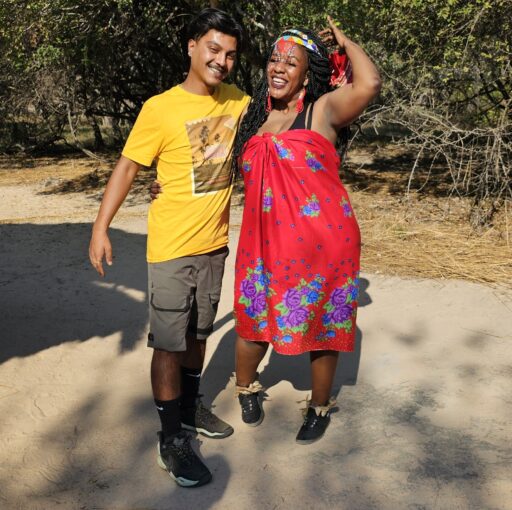
That afternoon, we watched Shaangan, Sotho and Zulu dancers dance the traditions of their respective peoples. This time, we were the only audience. Last time, I had joined two other tour groups of 30 Europeans. Privately, I compared the behavior of those groups to mine.
Last time, the dancers danced. The watchers filmed, enjoyed and applauded. The dancers danced faster, urging the Whites to clap with the beat. The watchers did, but so softly that nothing was heard. The dancers danced into the audience, urging watchers to dance with them. Most refused. Finally, the dancers finished in a rising crescendo of drums and enthusiasm. The watchers politely applauded, tipped and left.
My group was different. The dancers danced; the watchers cheered. The dancers clapped; the watchers clapped back. The dancers urged us to dance. Most did. The dancers completed their final crescendo. The watchers not only clapped but swarmed on stage to shake hands with each dancer. I heard one tell a Shangaan girl: “You’re beautiful, and you dance beautifully.” She almost collapsed with surprise. Afterwards, dancers and tourists stood around, talked to each other and made friends. Once again, a little interaction seemed more fun than merely saying “Thank you.”
Day 10: Poaching Syndicates: Asia, Arabs, Africa
Thousands of good human beings strive to preserve Africa’s wildlife. However, thousands of bad human beings strive to kill every animal in Africa. Their goals:
- Chop off specific body parts
- Advertise those parts as having near-magical powers (stop cancer, increase sex, cure hangovers, etc.)
- Sell the parts to wealthy clients, who are both wildly enthusiastic and completely deluded.
- If one animal is exterminated, select another, then make the same near-magical claims.
The illegal wildlife trade is estimated at $10,000,000,000 per year. South Africa loses about 1,000 rhinos yearly. Three die each day; one every 16 hours. Current poaching rates suggest they will vanish in 6-8 years.
The exterminators are organized into poaching syndicates. In China, one town (Suidong) is home to extended families that have stripped Africa of elephants for 40 years. Its operations extend to Angola, Congo and beyond.
Vietnamese syndicates exterminate rhino. Rhino horn—which is same material as fingernails—now sells for $65,000 per kg–more than gold, heroine or diamonds.
Arab syndicates kidnap cheetah cubs. Poachers follow a cheetah mother until she gives birth. They snatch entire litters, tossing them into crates for shipment across the Red Sea to the Arabian Peninsula.
The crates cross Somalia and then Yemen, both nations drowned in civil wars, thus without law enforcement. The few surviving cubs arrive in the United Arab Emirates. They are nursed back to health, then sold on Facebook for $10, 000 apiece.
The buyers, usually upper-class males, know nothing about cheetahs. They feed them cat food, ice cream, pizza and fast-food leftovers. They walk them on leashes, run them on treadmills, drive them in cars and sleep with them in bed.
Unfortunately, the cubs grow up, lose their cuteness, then are abandoned. Owners dump them in urban streets or the desert. Both choices equal rapid death; neither cities nor deserts hold the small game cheetahs need to survive. The fatality rate is 100%
Asian Poaching Syndicates operate on three levels. Chinese and Viet leaders make up the controlling level. They hire African Crime Syndicates, each based in an African coastal city. These recruit urban gangs, who may have previously focused on car-theft, house-breaking. etc. Gangs receive training in weapons, wildlife tracking, and bush survival. The syndicates provide weapons, vehicles, radios, wages, lawyers (if caught) and specific missions.
Anti-Poaching: Weapons and Tactics
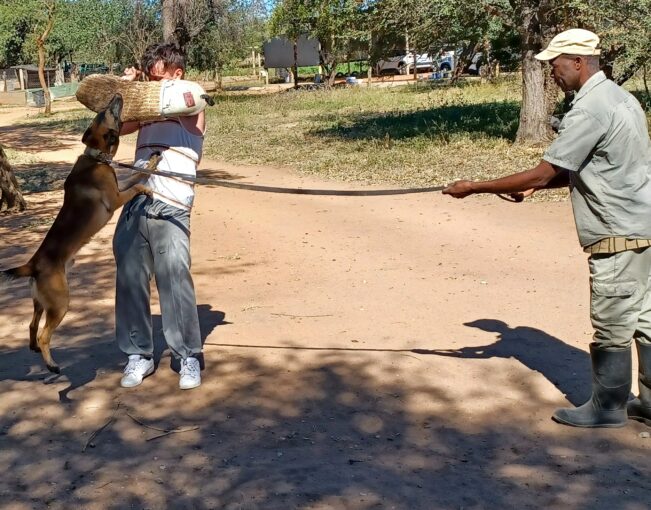
The weapon used most against poachers is dogs. Our group learned how by watching one dog handler squat down and place one finger in the dirt. By doing it she left both a track and a scent.
Some dogs are trained to follow a poacher’s “spoor,” any sign he leaves behind: a fingerprint, toeprint, broken branch, plucked leaf, even grasses he has bent underfoot. If he touches a tree trunk, the bark holds his scent. Other dogs follow scents in the air; man-smell, rhino blood, rhino horn, gun powder or even the smell of a bullet.
Dogs hunt in mixed packs. Some breeds follow spoor but don’t bite. Other types are trained to bite and hold. A poacher, caught by a barking pack, backs up against a tree, raises both arms to protect his throat, then kicks at every dog. Although armed they rarely shoot. South African law decrees that poachers who shoot dogs may be shot in turn. Poachers know this, thus do not open fire
Attack dogs, however, are trained to lunge at raised arms. They leap, bite, then hold as the poacher tries to either kick or shake one off. However, once seized, he is passed to police. On trial, he may be defended by syndicate-funded lawyers and go free. A conviction, however, may mean 25 years in prison.
To demonstrate how dogs attack, one of our group volunteered “to be a poacher.” Placing a thick, padded covering over his entire arm, he then raised it to cover his throat. “Attack,” called the handler. His dog raced forward, lunged upward, seized the arm, and then held on. No harm was done but the impact on us all—particularly the volunteer—was very strong.
Last Day: What Was Learned:
Then, suddenly, it was all over. There was nothing left to do but fly back to Silicon Valley’s corporations, cubicles and computers. No one wanted to go. During our final evening, fueled by South African wine, some did express these thoughts on which everyone agreed:
- Africa is not scary. It is welcoming.
- Africans are not scary. They try endlessly to make friends.
- Life is just more fun if filled with wild animals.
- To exterminate one animal means that birds, insects and even trees will die.
- To actually live with these animals is what made us love them.
And then, the group was gone—swallowed by a plane. Won’t you come and take their place, to live with—and maybe love—our wildlife?
_________
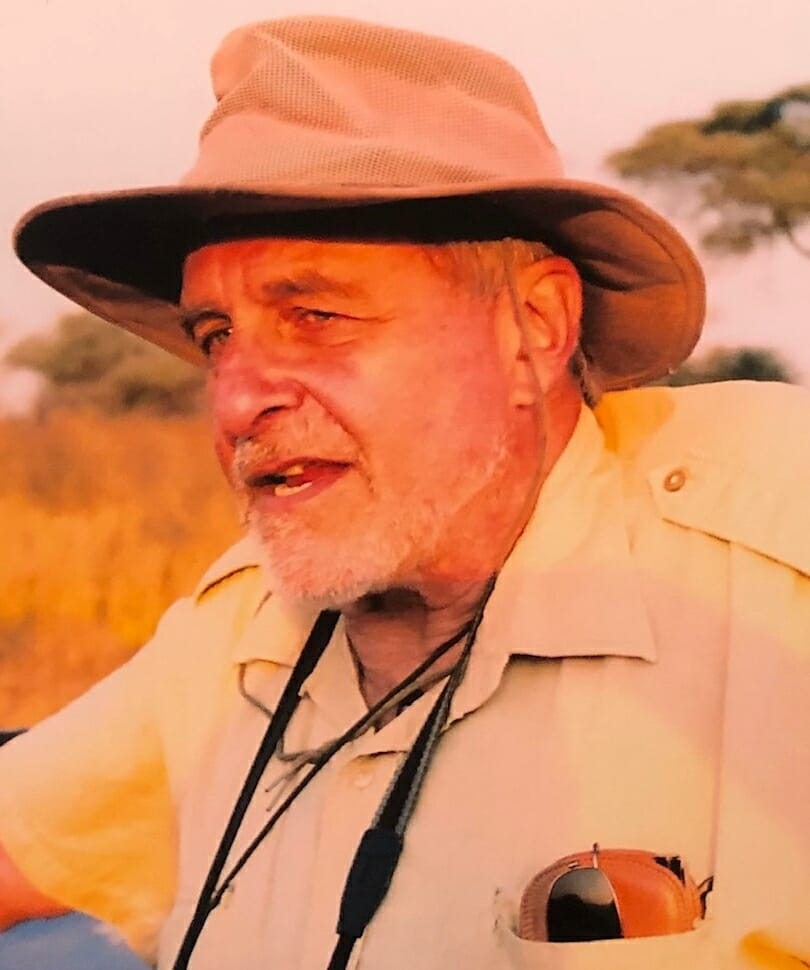
Jeffrey A. Fadiman is a professor of Global Marketing at San Jose State University in California, and a Language and Area Specialist for Eastern and Southern Africa. A graduate of Stanford University with two years at the Universities of Vienna and Free Berlin, this Fulbright scholar taught both U.S. and global marketing tactics at South Africa’s University of Zululand. He first experienced Africa in 1960 by canoeing up the Niger River to Timbuktu. Thereafter, he lived in Meru, Kenya, where he rediscovered the traditional history of the Meru tribe, which had been crushed by British Colonialism. Fifty years later, the Meru accepted him as the first White Elder of their nation. Professor Fadiman has supported both Tanzanian AIDS orphans and the schools to which he sent books, pens, paper, and hope.


Soumanou Salifou (administrator)
Soumanou is the Founder, Publisher, and CEO of The African Maganize, which is available both in print and online. Pick up a copy today!