

Revisiting the revolutionary dynamic in sub-Saharan Africa
The first of a series of articles on the subject
By Luc Abaki
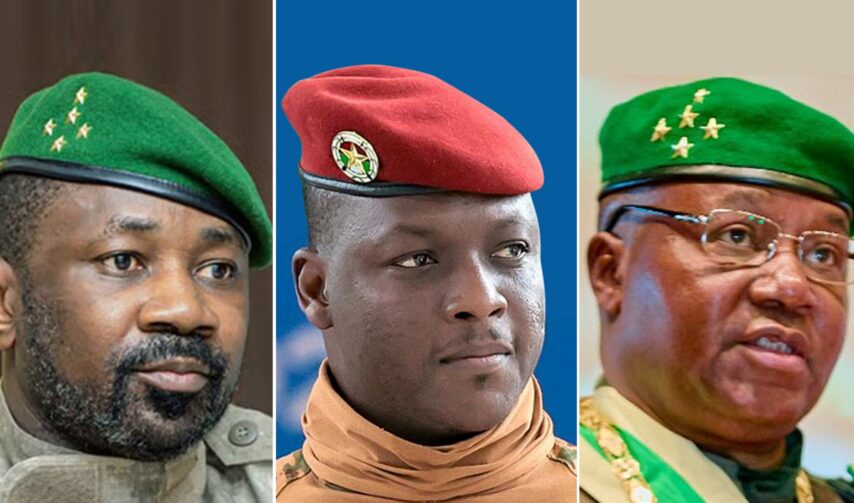
The tone of the new revolutionary dynamic in sub-Saharan Africa was set on May 24, 2021, in Mali by Colonel Assimi Goïta who was then commander of the special forces who overthrew General Baw N’Daw, president of the interim government. The public outcry aroused by this yet another coup in this country did not deter this senior officer and his companions who claimed their “resolve to get their country out of the clutches of external predators.”
Thereafter, Captain Ibrahim Traoré orchestrated another coup d’état, on September 30, 2022, in Burkina Faso. Colonel Paul-Henri Sandaogo Damiba who held the reins of this country had to take refuge in neighboring Togo. Then, on July 26, 2023, Niger entered the dance with General Abdermane Tiani, causing the fall of President Mohamed Bazoum, now kept in the bonds of detention in Niamey.
In the three countries, which are prey to terrorism and political instability, the ambitions demonstrated by these new leaders remain the same: definitively break away from Western imperialism, put an end to terrorism and the predation of resources, as well as the political hegemony of the world’s powers which are thought to be the main cause of the ambient precariousness that permeates most of the former French colonies in Africa.
Clearly, it was a daring move in a French-speaking West African region where most of the leaders have always shown docility and submission to France, the colonizing country of yesterday. As a result, these officers are fiercely fought not only by the colonizer of yesterday and its allies, but also, and above all, by their African neighbors, members of the Economic Community of West African States (ECOWAS). This sub-regional organization multiplied, often clumsily, economic, financial and political sanctions against them. The goal was to asphyxiate their people and force them to rebel against these audacious officers whose real sin was to shake up the centuries-old establishment in this region.
But the firm will, the unwavering determination as well as the resolute commitment of these soldiers ended up taking root in the hearts of their people, with real faith in them. These citizens ultimately constitute their main shield, with a resilience that facilitates the progressive implementation of this revolutionary policy in the three countries, despite the external revolt which hardly weakens.
Since taking the reins of their countries, these brave soldiers have taken steps in almost all areas of the life of their nations, moving in the direction of asserting their sovereignty. Skillful as they are, they have made good political choices and acted in a synergy that strengthens their capacity for action, which gives them room for maneuver.
At the outset, they instilled hope and dreams in the minds of their people with a new narrative, a revolutionary discourse that made it possible to mobilize them around the major ideals that bring together, motivate and determine each citizen to action. Once the firm support of the majority of the people had been acquired, these leaders activated the implementation of their action plan intended to free their countries from the yoke of toxic imperialism.
On the one hand, the three countries denounced the military agreements which had kept them essentially under the fold of France and kicked out the external forces based on their territories. On the other hand, they created on September 16, 2023, the Alliance of Sahel States (AES), an organization aimed at forging a community space conducive to the economic development of these countries rich in natural and mining resources. Together, they set up a joint military force to fight terrorism in addition to restructuring their respective armies and equipping them accordingly, in order to dismantle the sanctuaries of these enemies of the people.
Despite the small controversies about the results that these states have achieved in the fight against terrorist networks, it remains obvious that many localities formerly under the control of these groups have been recovered in Mali as well as in Burkina Faso and Niger. And this phenomenon is less and less endemic than it had been before these officers came to power.
Concerning this military aspect, it is important to note that the three countries benefit from decisive support from Russia and other partners such as China and Turkey. Russia, for example, provides them with technical assistance with military personnel as well as equipment, planes and armored vehicles, among other things. The credo of these countries remains to establish win-win cooperation in all areas, without any kind of influence or domination whatsoever, contrary to the case with France whose shadow continues to loom over the life of almost all regimes in French-speaking Africa.
In this logic of emancipation, Assimi Goïta, Ibrahim Traoré and Abderman Tiani announced on December 24, 2024, the exit of their countries from ECOWAS which became “part of the problems of the AES,” according to Abdoulaye Diop, the Malian minister of foreign affairs and international cooperation. In all, the Alliance of Sahel States no longer intends to be complacent by continuing to be members of organizations whose autonomy and independence are questionable. Furthermore, it advocates rigor in state governance and in the fight against all the scourges which undermine the affirmation of African identity, the emancipation of the citizen, and the development of these countries.
To fulfill this development objective, several ambitious projects have already been initiated, including the imminent creation of a confederal investment and development bank which will serve as a financing instrument for structuring projects. Added to this is the nationalization of gold mines in Mali and Burkina Faso as well as that of uranium in Niger. The exploitation of their deposits by the authorities of these countries makes it possible, in particular, to better support and control their economies.
But major challenges remain regarding the effective materialization of this noble ambition of securing the independence of these countries. Among others, their membership in the CFA franc which has constituted, until now, the currency of the eight countries comprising the West African Economic and Monetary Union (UEMOA) and always guaranteed by the French treasury.
But, beyond this reality, will the three countries be able to stay the course by persevering in this logic of sovereignty without leaving any detrimental loopholes? This challenge could possibly be met, provided that, in addition to being vigilant, these leaders strengthen, through their style of governance, social cohesion, the effective participation of all citizens in the political, economic and social life of their countries, as well as the firm fight against corruption and the embezzlement of public funds which are prevalent in Africa.


Soumanou Salifou (administrator)
Soumanou is the Founder, Publisher, and CEO of The African Maganize, which is available both in print and online. Pick up a copy today!