

“Damn the Novel!” An author’s cry against a privileged genre
In a series of forty-five short essays that constitute his book translated into English under the title “Damn the Novel: When a Privileged Genre Prevails Over All Forms of Creative Writing,” Sudanese-born poet and essayist Amr Muneer Dahab denounces the privilege granted to the novel, the literary genre that is treated by publishers—and viewed by the public—as superior to all others and is virtually guaranteed marketability and profitability, to the detriment of others.
In this series of posts, the prolific author shares excerpts from the book.
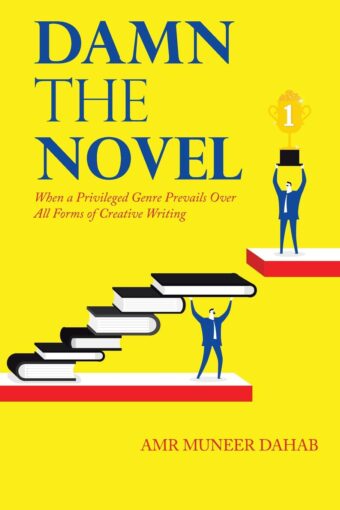
This week: Chapter 36
Women and the Novel
One cannot judge any kind of work without regard to the producer of that work first, assuming we know who’s responsible for the work in question. Otherwise, if the author of the work is anonymous, we tend to imagine its source as we make a judgment based on that imagination. This can be true for every work in life whatsoever, not just literary works.
There are many stories being told (real or fictitious) of writings attributed to famous people, other than the real authors, and they were welcome with a great deal of admiration if they were attributed to real authors, or to those who are less famous. I remember one story (probably not real) in the opposite direction. It was claimed that the Egyptian writer and literary critic Taha Hussein, during a time when he was minister of education in Egypt, was disturbed by the rigor used by the teachers of Arabic while correcting composition. Hussein wrote an essay and told his staff to insert it between the essays of the students so as to see how the teacher would deal with it. The drama of the (made-up) story continued until we finally knew that Hussein’s writing got a mark of 7 out of 10.
Not so far from the main theme, Al-Jahiz’s quote supported the main theme; he said that some jokes never reached their humor without mentioning their creators. It was said that if some storytellers wanted their funny story to reach a wide audience, they would make its protagonist someone who is famous with humor among people. In this case the writer here is seeking fame through the easiest possible way: making it fake. Though the main idea is that judging literary works is something impossible and might surpass the author or the protagonist, even in the case of an imaginary protagonist, as seen in the above paragraph.
Women are half of society, sometimes with a slight exaggerations in statistics (whether that is for her benefit, or for the benefit of men, in accordance with the place and time where the statistics are made, bearing in mind the difference in societies). But in literature, the percentage is so oppressive against women. (What about the different aspects of life when it comes to concrete contributions of women in social life, and not only abstract numbers?) Here we are not speaking of whether women are outnumbered by men or whether it is nature’s law. Whatever, the specificity of feminine literature is a reality even before the rise of feminist theory in literature; we recall that it is a reality in the general framework since judging literary works is impossible without knowing the gender of its author. It is impossible for authors to come out of their bodies in order to create a literary work. The deep implementation of the Death of the Author for me lies in the possibility of opening far and precious horizons to read all that creation coming out from the author’s unconscious outlook on human existence.
In his book The Author, Andrew Bennett suggests: “It is for this reason when we try to study the obvious ways by which men and women are represented in a literary work as of Daniel Deronda, we care more about the fact that George Eliot was not a man even if she was hidden under a pen name. For example: it’s very important for Kate Millett in her prominent book Sexual Politics 1971 that the author of the controversial novel Sons and Lovers was a man who gated women. Would it be the same thing for structural criticism? Said Andrew in the context of exposing the feminist theory in the mentioned book, which was introduced by Millet for the sexual ideology of Lawrence, let us say that Davina Henrietta was the author. The point that Millet is trying to make is, by taking into consideration the social situation of that time, the novel of Sons and Lovers cannot be written by a woman.”
It was possible that women might benefit from the concept of the Death of the Author if the absolute equality between the two sexes—in literature and life—was the ultimate goal. But that is impossible due to the nature of things, let alone that it is not the initial/original goal of the proponents of equality between the sexes.
It was logical that the theory of the Death of the Author goes against the peculiarity that feminist theory grants to women in literature. Bennett sees the following: “When it was like that . . . some critics recognize a specific determinism and a historical approach in the said attitude. Since the time feminist theory called for a literary tradition for women, critics declared the death of the author.”
What is special in the relation of women with the novel apart from the other literary genres? In the Arab context, poetry was the pioneer in Arabs’ souls. Even before the rise of ideas and modern theories such as the feminist theory and the Death of the Author, and due to the unchangeable nature of the Arab society in the past and in the present as well, the female poet used to be distinguished by her feminist poetry, and this distinguishing mark was blessed by her and her society as well.
I believe the most particular point is that the woman was a subject of poetry more than a (female) poet. And by the coming of the novel, this matter was portrayed clearly. Woman as a subject in the novel is more obvious and persuasive than the woman as a narrator or novelist. Of course this is not an underestimation of the female authors as much as it is a validation of the historical truth about women’s effect on men and on life in principle. Even Eve—if she were to be compared superlatively with Adam—has the ultimate right of taking hold of drama in literature, as she has the right for existential privacy in life (I hope the expression is fitting). Adam is the absolute Human; whereas Eve shares with Man the general meaning of humanity, and then smartly maintains her particularity as a female (which lies in the opposite direction from struggling for equality between the sexes).


Soumanou Salifou (administrator)
Soumanou is the Founder, Publisher, and CEO of The African Maganize, which is available both in print and online. Pick up a copy today!