

“Damn the Novel!” An author’s cry against a privileged genre
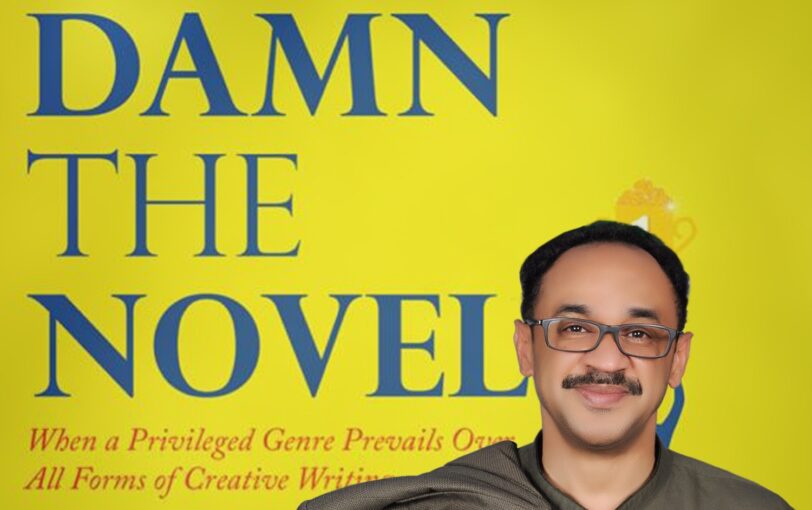
In a series of forty-five short essays that constitute his book translated into English under the title “Damn the Novel: When a Privileged Genre Prevails Over All Forms of Creative Writing,” Sudanese-born poet and essayist Amr Muneer Dahab denounces the privilege granted to the novel, the literary genre that is treated by publishers—and viewed by the public—as superior to all others and is virtually guaranteed marketability and profitability, to the detriment of others.
In this series of posts, the prolific author shares excerpts from the book.
This week: Chapter 25
Which One Is Hard to Write, the Novel or the Essay?
“What I feel towards writing depends totally on what I am working on. Now I am writing an essay about marriage. It is so tiresome. I feel that I am sitting on the black asphalt of a highway, writing insanely, while the eighteen-wheel-trucks are heading towards me fast; I can be crashed at any moment.”
Then American writer Ann Patchett proceeds in Why We Write: “Narrative literature is different because when you are writing you are just trying to tell what happened. I always feel that I am looking askance at something very far during a blizzard trying to figure out what it is.”
Ann Patchett is an American writer whose many popular novels have won various notable international prizes. She also writes essays in prestigious newspapers such as the New York Times, Chicago Tribune, Boston Globe, and others. Still, Ann Patchett perhaps cannot be the best one to answer the question posed in the title. Probably the most beautiful detail in the quote about the distinguished author is that she is not trying to answer the complicated question independently. She tried to answer it casually while talking about her experience as a writer. The most interesting point is that she showed the difficulty of writing in both areas without providing a definite answer, even from the perspective of her autobiography.
However, it is not a shortcoming when a writer tries to give a definite answer in this regard considering his own personal experience with writing. The problem starts when writers who align with one literary genre opt for judging other genres they did not experience (or tried and failed) describing them as easy to handle. Doing this, they grant their literary devotion complexity and subtleness—as if saying they are practitioners of some unique art that not everyone can deal with.
The most dangerous issue is when critics (no matter how artful) get involved in this mission: evaluating superiority among genres from the perspective of writing constraint(s). The danger here lies in the fact that people will consider the statements of critics as the most likely to definitely close the case—as if they were laboratory experts who analyzed the degree of difficulty between different genres through the most sophisticated devices of a “literary digital thermometer.”
If a writer possesses enough daring to decisively state that it is more difficult to write in one genre than in another that he/she had practiced, it means the writer was lucky enough to run his pen (or his fingers on the keyboard) within the (easy) genre he/she aligned with faster than running his pen within the other (tough) genres.
Before expanding comments and analysis, we have to refer to what can be considered as facts in this context. The degree of difficulty cannot be the scale to measure the quality or the pleasing aspect of literature. So, if it is accepted that a genre is more difficult to handle than other genres, it does not mean the fruits of the more difficult one are more delicious and beneficial than the fruits of the other (light) genres. The matter here seems as if it always depends on relativity of judging the benefit and the pleasing aspects, either by readers or even by critics, no matter how some of them may talk about possessing the absolute judgments about everything within the literary context in people’s life.
Ann Patchett somewhere else in the same book proceeds with her statements: “I really love writing essays. But now I am writing fewer ones because there are few magazines. I enjoy it but I can never sit down to write an essay if no one asked me to. I knew very earlier that I could earn as much money writing essays for magazines as when teaching. Writing for magazines is much easier.” What is Patchett doing here? She is comparing writing essays and teaching. There is nothing wrong with it so far as I can see as long as the issue is related to the choice she had to make to get money and not for the absolute preference of the benefit and the pleasure of a particular literary genre over other genres. As a transient note in this context, I still insist on disagreeing with the English saying because the comparison shouldn’t always be “apples to apples.”
Ann Patchett turned again to comparing the essay to narrative literature. And I am not quite sure here if this will can be described as an apples-to-apples comparison. In the words of Patchett: “The non-narrative literature is totally different from the narrative one. If you are writing a book of 800 pages about the Chihuahua, you will need to make sure that no one else will compile a book about Chihuahuas before you do. And this is not an actual problem that novels face. Concerning the narrative literature, I have never sold a book before finishing it. I will never do. I write narrative literature in its wholeness for myself. I write the book I want to read. It is the story in my mind which I couldn’t find in an existing book. The commercial success, or the expected commercial success, of a book has no power on me.”
But Patchett (even after the above comparison between two apples) is still far from elaborating a definite stand, through her experience, about the difficulty of writing in the two genres at the level of writing technique itself, not about the financial benefits mostly based on conditions of the publishers and the market (of books).
David Baldacci in one of his statements in the same book (Why We Write) also went through comparing between two apples but in a direct manner, even if the second apple in Baldacci’s comparison was the detective novel, not the essay. Baldacci wrote: “I will not be able to write a novel as a ‘mystic option.’ And I will not write a book that wins the Pulitzer Prize. I do not think that it is what I am doing, and that my talents lie here. Novels that win similar awards are characterized by depth. Both language and plot within it have the same power. . . . Can I spend five years of my life writing a book instead of writing a ‘commercial novel’ in seven or eight or ten months? I am not sure if I own the background and the talent to do so. The people who write narrative fiction are more organized. They spend years and years of their life on one project. This distinction between ‘literary novels’ and the ‘commercial novels’ is killing me. . . . I attended many writing events across the country and met many wonderful novelists who welcomed commercial fiction with big heart like I did. As if someone of them was telling me: Hello friend! But on the other side, I found much hostility. The commercial side complains: I write books of the same quality as yours but I don’t win any prizes. And the literary side complains too: I write books better than yours but I don’t sell any of them.”
The statement of Baldacci reveals that the battle is not always between two different literary genres like the story and poetry or the novel and the essay (we mention the latter deliberately as in the title). War can be declared even among subgenres of the same literary genre, between “literary fiction” and “detective fiction” as David Baldacci mentioned.
Ray Bradbury says that he wrote Fahrenheit 451 in nine days. It is a science fiction novel categorized as philosophical fiction. So it is not a “transient detective novel.” Besides, many writers and artists swear that the best of their work took no notable effort from them. Thereby, the degree of writing difficulty does not seem to be a dependable scale to judge the quality and the value of a literary piece of work.
Because we are exposed to such an artificial analogy (conflict) between narrative fiction and the essay form, what really counts for me is confirming that the essay genre is able to accommodate, based on the talent of its writer, multiple expressive methods capable of creating deep insight along with pleasing subject matters. So it will be of no oddness for someone like me to eye the essay as a rival having more privilege than detective novels competing with literary fiction.


Soumanou Salifou (administrator)
Soumanou is the Founder, Publisher, and CEO of The African Maganize, which is available both in print and online. Pick up a copy today!