

“Damn the Novel!” An author’s cry against a privileged genre
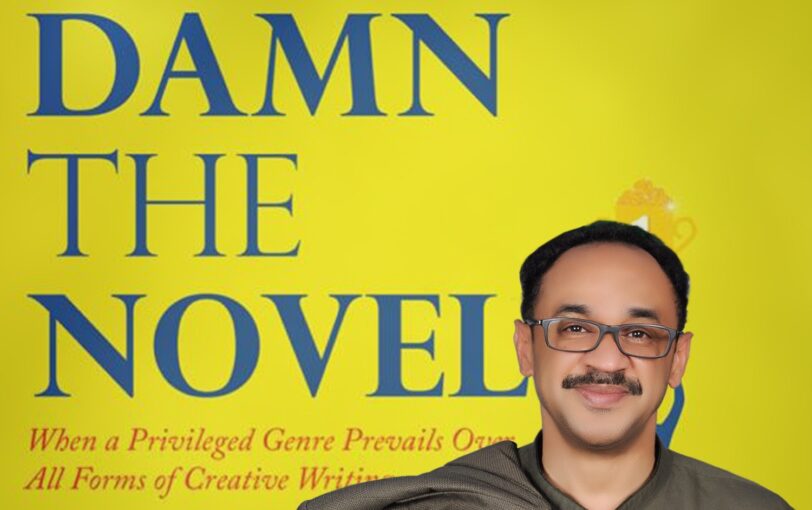
In a series of forty-five short essays that constitute his book translated into English under the title “Damn the Novel: When a Privileged Genre Prevails Over All Forms of Creative Writing,” Sudanese-born poet and essayist Amr Muneer Dahab denounces the privilege granted to the novel, the literary genre that is treated by publishers—and viewed by the public—as superior to all others and is virtually guaranteed marketability and profitability, to the detriment of others.
In this series of posts, the prolific author shares excerpts from the book.

This week:
Chapter 23: An Early Justice Toward the Essay
It seems that it is wise to blame the essayists before blaming the critics and the readers if the former have felt inferiority complexes toward the other literary genres such as poetry, the story, the novel, the play, and others. It is most likely that essayists have really felt so. They feel that it is better for them if they could (perhaps even longing) become poets or novelists.
Indeed, claiming superiority for a particular profession is common. And it is also widespread among branches (specialties) within the same occupation. This is because people consider the income potential of the efforts required in that particular profession, and often because claiming superiority depends on the evaluation of the people regarding the difficulty of practicing a profession, or just the impression of people in general.
Interestingly, the battle (fever?) of superiority among the branches of the same profession or the same art is first waged by those who belong to this profession or art before the others (outsiders) join the dispute. Some who belong to a given branch may endorse the idea of undermining what they are exercising (profession or art) when it is stated that it is inferior to the other branches; thus they become victims of the concept that some arts are superior under the influence of the reasons mentioned above or under the influence of any other stimuli.
For me, the idea of “infinite horizons,” or “no limits,” seems to be a standard equally applicable to all sorts of creativity and all other fields. In other words, I mean every sort of art is bottomless, but when practicing it just for living, then such level of difficulty/superiority could be applicable, while when the target is absolute creativity, then no standard classification (among all different fields) could be applicable/acceptable. Therefore, I have no objection to the assertion that a given branch of the arts generally requires more effort than another branch of the arts, regardless of talent. However, when the competition is among art created with no limits, talent cannot be ignored and even participating in the race (with no limits) will be restricted to the gifted alone. So, those who simply say that a writer can be a genius in storytelling in the same way as in poetry are like those who say that the infinite horizons of the story are closer than the infinite horizons of poetry, and this cannot logically be accepted before being considered through specialized analysis.
Antecedence in terms of emergence does not apparently have a significant effect on raising the value of an art branch over another. But the antecedence in terms of steadiness in the process of establishing that particular art has an effect among people in the sense that they regard that sort of creativity as the origin of all arts. Accordingly, some people’s consideration of which art is the antecedent (for example: is it the novel or the essay?) is of no use. Reasonably, besides the difficulty of determining what makes a completely perfect novel or essay, people see the history of events differently, even for the events that are not so long ago. In short, the most important thing is that the antecedent literary art is the history of sciences, as a whole, and the history of literature and arts in specific. So, counting on the issue of antecedence to judge the perfectness and supremacy of a given genre cannot be a precise criterion.
Still, when talking about antecedence, we can say that new genres have their supremacy just as old genres have their charm. It is most common that an art or a branch of some creative activity swiftly spreads because it is a new vogue in literature or art, so people passionately and eagerly appreciate it under the concept of “fashion of the time” . . . but for not more than that. And just as revering the old genre just because it is (historically) old is a mere invented process that does not logically fit, worshiping the new genre just because it is new is also an invented act that is not logical. In reality, both (defective) approaches/processes are being performed. People, practitioners, and the general public may resort to arguments; still, they mostly hold a specific stance either because they are yearning for the past or because of looking forward to modernity. As a result, the supremacy of a given art or genre remains confined within a set of factors far from the practitioners’ excellence or creative talents.
Among Arabic literary arts, poetry has held absolute or semi-absolute supremacy for centuries. Poetry was not rivaled by any prose genre, which incorporated all unrhymed literary genres in limited forms. The story, or even the novel or the play, saw light only few centuries ago. As for the spread of the novel and story to the extent of seriously competing with poetry in occupying the hearts of Arabs, it did not happen until about few decades ago. If indications of threatening the throne of poetry have intensified during the last quarter of the previous century, the seizure of literary supremacy within the souls of Arabs by the novel in specific (not all narrative genres) has been mostly a recent event of less than ten years ago.
In the same way, the essay remained till the present time an influential art that no one dared to introduce as capable of holding supremacy without leaning on poetry or on narrative fiction. Actually, there are writers and readers who prefer poetry and essays over the story and the novel (as we saw previously with Abbas Al-Aqqad). There are others who do not like poetry and instead resort to the essay form of prose (social or political) but cannot totally prioritize it over narratives.
So, having a man of letters writing explicitly and appreciatively about the essay half a century ago is an event that deserves mentioning and praise even if the notice was transitory (that is to say, it occurred within the details of another issue). The Egyptian scholar Salah Zihni in his essay in Al-Risala meant to only criticize the critical comments of Mohamed Kotb about the two essays on narrative fiction he published in the same magazine about the two Egyptian writers Mahmoud Taymour and Naguib Mahfouz.
Zihni stated: “I was surprised and I commiserated with Mr. Kotb turning around Taymour so he exhausted the man and himself too. If he had known while he was rolling around Taymour that he also inserted three others in fields which are not theirs, he would have preferred to give himself some rest even if no one reacted to him. Hasn’t he inserted Tawfiq al-Hakim as a man of storytelling while the latter has no hand in it, nor was he a school leader in the field of story? Hasn’t he inserted Professor Elmazni as a story writer? With due respect that I, and many others, have for Almazni, none dared to say that he has an independent school in the art of story writing.” Then he continued: “The second one is our issue here. The most interesting thing is that Mr. Zihni was not concerned with details between the genres such as the short story, the novel, the essay. But he was mainly concerned with precise classification of these genres based on the (literary) output of the writers he mentioned.”
Without going back to the two essays by Mr. Kotb and Salah Zihni, classification of theories, schools, or literary groups is an issue that clearly brings up disagreement. What is important here is not who is the right one of the two, Mr. Kotb or Salah Zihni. (It is worth mentioning that the list of Almazni’s work, which some publishers put in the list of his books lately republished, include writings that some consider as essays and ones that some consider as narrative fiction.)
The most important part of Zihni’s suggestion is that he is talking with great literary respect for Almazni despite (?) his insistence of inserting him in only the category of essayists. That’s an action that seems trivial to someone like me, but it is also difficult to find someone to consider this action nowadays; not for doubting Almazni’s contribution to Arabic literature during that era, but due to disregarding the value of the essay in the present time as a totally independent genre. It means ignoring the fact that the essay can walk side by side with poetry and the novel and perhaps exceed them if circumstances allow. By circumstances, we mean those similar to the ones that made the novel overtake poetry and caused poetry to fall from its deep-rooted throne in the conscience of Arabs . . . so why not?


Soumanou Salifou (administrator)
Soumanou is the Founder, Publisher, and CEO of The African Maganize, which is available both in print and online. Pick up a copy today!