

“Damn the Novel!” An author’s cry against a privileged genre
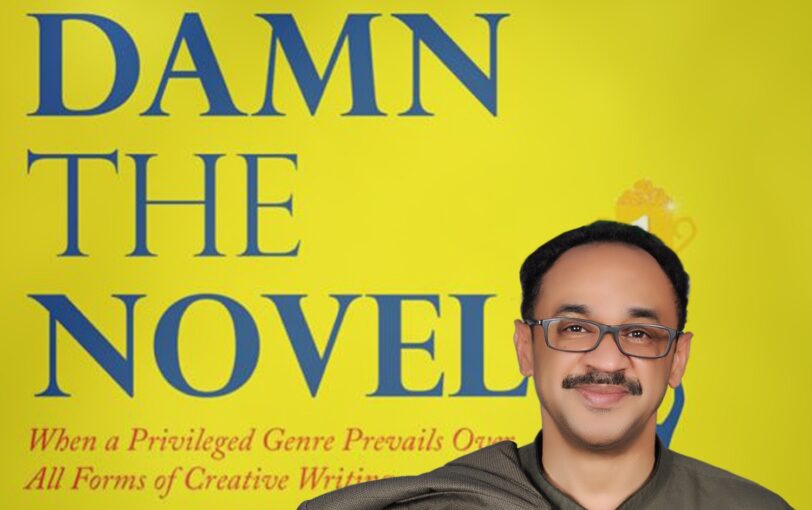
In a series of forty-five short essays that constitute his book translated into English under the title “Damn the Novel: When a Privileged Genre Prevails Over All Forms of Creative Writing,” Sudanese-born poet and essayist Amr Muneer Dahab denounces the privilege granted to the novel, the literary genre that is treated by publishers—and viewed by the public—as superior to all others and is virtually guaranteed marketability and profitability, to the detriment of others.
In this series of posts, the prolific author shares excerpts from the book.

This week: Chapter 45
Every Writer Can Do Something Else
In Why We Write, the American novelist Ann Patchett says: “I swear to God I write because I know nothing rather than writing. Since my childhood I knew that writing is going to be a part of my life. I didn’t have any doubt about it. Making such a decision rendered my life meaningful; I put all the eggs in one basket, and here we are, having too many eggs.”
Patchett swears that she doesn’t know anything but writing. Actually, I don’t believe her and I don’t want to accuse her of lying, too. She doesn’t know that she can do many things along with writing or even without writing if obliged (given certain circumstances of life).
However, Patchett is totally right in the other part of her statement, confirming that writing is going to be something very efficient in her life. The same thing happens with anyone deciding to treat the career he is about to launch accordingly, with only a warning that the concept of “efficient” refers to good productivity leading to success some way or other. Someone may wonder: What should efficiency mean otherwise? The only answer I have is that experience throughout different horizons/perspectives of professional life, or within the same career, may lead to success in every possible way (though sometimes poor in quantity but with unique/original quality).
If life flows as planned, that would be something rare. We gave an example of someone who was longing since early childhood to be an ear, nose, and throat specialist, and we saw that such case cannot be considered as a healthy phenomenon because it hides for the person many horizons where he might produce more and more fruitful and special work. Of course, it does not mean one has to miss the opportunities granted by life by deciding beforehand to abruptly engage in the labyrinths of human existence/experience. In fact, rocky routes that were unforeseen provide many surprises and joys, apart from the many lessons that come with opting for the tough choices rather than enjoying the simplest shortcuts to “easy” happiness.
Patchett has the ability to do many other things other than writing. In fact, she doesn’t have to, and she didn’t try to. Not too different from Patchett, we have Kathryn Harrison who states in the same book: “I write because it’s the only thing I know and the only thing that makes me worthy of being loved.” The difference between the two is that the first feels pride of her success in life through writing and how discovering her talent from the very beginning was useful and vital to her whole career as writer, while the second stresses her feeling of satisfaction only for the fact that writing has made her able to steal into the hearts of her readers.
The American poet Mary Karr states in the same part of the book: “Right now I don’t make my living as a writer, but as a university professor instead. I cannot pay the bills from the sales of my books. The myth says that you become rich when you publish a book. Unless that book is welcomed by the masses (of readers), that is totally nonsense. Starting from my fifth year (she means of her career) I always introduce myself as writer and that has nothing to do with payment. I always tell people that I am a poet if they ask me and I keep saying so till now.”
Unlike Patchett and Harrison, Karr says: “Before becoming a university teacher of English, I used to run a bar where I worked as a receptionist; I had a funny job in the telecommunication sector. When I stopped drinking, I was a writer for Harvard Business Review and I received payments from time to time. I started teaching when I was pregnant with my son, who is 15 years now. I gave lessons at Harvard for $5,000. I taught another course at Tufts University for $3,000. I also gave another course at Emerson College for $1,500. During the five years I had been teaching across different institutions in Boston, I could not live with such revenues. Accordingly, I kept writing essays about marketing for Harvard Business Review. This has not developed any of my writing skills or expertise. It just helped me to survive.”
It’s not important to consider the comparison adopted above. We are not sorting out who is the best in terms of writing approaches or methods, as I am not willing to make you believe that Karr’s experience is worthy of consideration as an effective experience, simply because she tried all sorts of work before she decided to devote most of her time (life) to writing.
In short, every writer can do something other than writing, even if that “thing” might be less beautiful/valuable than writing itself. We cannot narrow the circle of creativity to only include one privileged literary genre. We cannot live under the illusion that there is a period of time (an era) for every literary genre to prevail and take over the interest of the audiences. It is illogical to apply the standards governing the arena of “fashion” on the literary and cultural life of people on earth on the basis that every literary trend should respond to the mood of the public/audience eager for the new and the revolutionary so as to quench a thirst for creativity and pleasure. Thus, the trend of the novel is on its way to an end, while another trend is being created somewhere.


Soumanou Salifou (administrator)
Soumanou is the Founder, Publisher, and CEO of The African Maganize, which is available both in print and online. Pick up a copy today!