

“Damn the Novel!” An author’s cry against a privileged genre
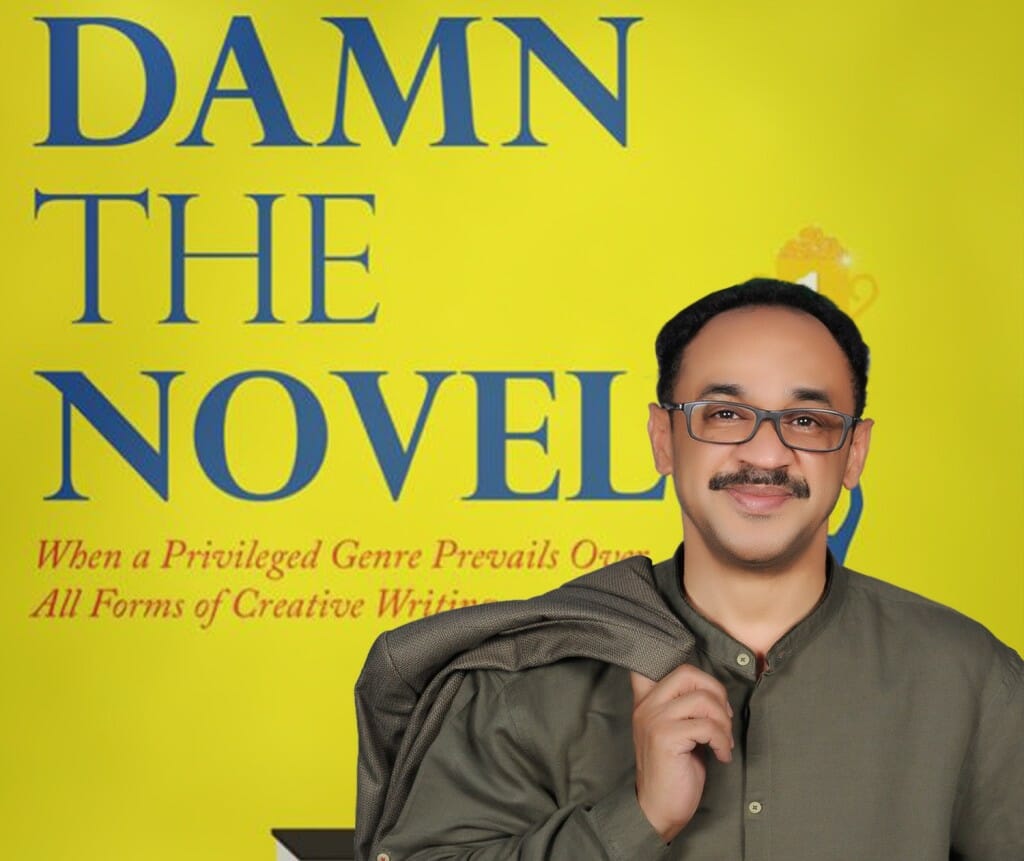
In a series of forty-five short essays that constitute his book translated into English under the title “Damn the Novel: When a Privileged Genre Prevails Over All Forms of Creative Writing,” Sudanese-born poet and essayist Amr Muneer Dahab denounces the privilege granted to the novel, the literary genre that is treated by publishers—and viewed by the public—as superior to all others and is virtually guaranteed marketability and profitability, to the detriment of others.
In this series of posts, the prolific author shares excerpts from the book.

This week: Chapter 43
Not Every Interesting Book Is Necessarily a Novel
“I still believe that we are not really living the Era of narrative fiction especially with the absence of mechanisms of assessment, promotion, distribution and conception. It has been a time of retreat of the said novelistic privileged genre as it was the case with other literary genres (like Epic and other great classical genres) throughout the history of literature. There is something subtle taking place in the Novel’s Castle. Even the Nobel Prize went out from its traditional approach to literature broadening it so as to include other parallel categories co-existing besides the novel such as lyrical text with Bob Dylan, in addition to the investigative/narrative/political journalistic reports. That means something is going on inside the body of the novel and tears its classical specificity and even its ‘sanctity.’ There are other types taking the lead in literature which doesn’t have the characteristics of the novel as it was known, written and perceived before.”
In an essay published in Sharjah Magazine in 2017, as mentioned above, Wassini al-Araj amazingly and interestingly dealt with the love both Tayeb Salih and Mahmoud Darwish used to have toward an art they did not perform since they saw it with the eye of a reader and not a creator. It is somehow similar to my notion about “between the novelist who adores verse and the poet who adores narrative fiction.” Both Salih and Darwish are good examples of contemporary writers illustrating deep reconciliation between different literary genres, a model of (literary/artistic) reconciliation worthy of being described as an instance of “peace and insight.”
Al-Araj exceeds what we termed “deep reconciliation” between Salih and Darwish to embrace some “comforting daring.” He in fact did not only reveal his admiration for a different literary genre (from the one he is known for), but he also had the courage to stand against the slogan of the “Novel’s Era” which is about to take the lead in Arab literature as an unquestionable postulate. He even greatly welcomed awarding the Nobel Prize to certain unconventional literary variant genres (some of which have been condemned even in the West). Furthermore, he confirmed his feeling of doubt in regard to the future of the novel’s peculiarity and majesty.
However, Al-Araj’s “comforting daring” did not stop there. It even pronounced the imminent death of the novel (besides the other forms of creative writing). In connection to his declaration above, he proceeds as follows: “narrative fiction being practiced/experimented by whoever want to ‘write.’ In fact the stigmatization of novel writing is not an instance of unique creativity, nor is it a part of a process of democratization of writing given to the literary ‘products’ being created lately. Instead, they are signs of the gradual fall of the novel till it will be paralyzed along with its effectiveness as an independent genre open to renovation and modernity. It’s a new time coming to eradicate all sorts of written literary products, not only the novel, in the light of the flagrant domination of visual arts and social media which ‘has stolen’ every possible aspect of life and impact from classical/conventional literary genres, if these genres are not willing to accept the requirements of a surprisingly changing contexts where they live.”
Al-Araj says that the novel is not that powerful candidate (it used to be) for the throne of literature arenas anymore, adding that all conventional written literary genres, too, are not capable of taking hold of the domination over the world of literature and over audiences. This is happening while social mass media keeps reinforcing the new “Visual Era.”
David Baldacci was also concerned about the matter of the new trend in the eyes of modern circumstances that govern the work of the novelist. In Why We Write, the American novelist said “I cannot write a novel like Sophie’s World and I will not write a book that can win the Pulitzer. I don’t think that my talents exist in here. Novels winning such awards are deep, where the language and the story are going strong and subtle (hand in hand). Can I spend five years of my life writing one book rather than writing a ‘commercial novel’ (product) which might take only seven or eight or ten months? I am not sure whether I have the background and the talent to do that. Story writers are well organized; they spend years and years in one project. They can benefit from everything they have (skill and talent) to work on that very story.”
Unlike Al-Araj, Baldacci doesn’t seem to be patient and peaceful in front of his competitors in the field of “literary novels,” which are full of deep insight as he describes. He keeps raising the question with a distressed tone: “This discrimination between commercial and literary novels is really killing me. It’s like dividing one unity into two (different parties). Something like breaking the union between The American Federation of Labor and Congress of Industrial Organizations. Who will encourage this process? The big companies of course.”
However, Baldacci keeps relating his experience, but more peacefully this time: “It happens that I went to many book-related gatherings in the every part of the country, I met many novelists who accept ‘commercial’ writers like me with open mind. As if some of them were telling me ‘welcome, my comrade!’ On the other hand, I found much enmity too. The ‘commercial’ party is complaining: I write good books just like yours, but I don’t win any awards. While the literary party complains: I write books better than yours but I can never sell any.”
In another attempt, Baldacci is trying to express his view, with some kind of objectivism though mixed with anger, insisting that his commercial novels are worthy of interest and success compared to their privileged literary counterparts, adding that “someone asked John Updike, why don’t you write a mystery novel? He replied: I am not that smart. Updike wrote many wonderful books and won two Pulitzer Prizes but he’s got different skills/talents. The same thing happens to me. I can never write Rabbit, Run. Writing mystery novels needs much planning and well-developed plot. It’s like putting a bomb in page 4 and it will not explode until page 400. Even worse books require some talent to write them.”
I was amazed once when I was at a book fair. A reader was insisting on buying one of my books (I was there for the book signing of that particular title) from other books that the publisher was trying to persuade him to get. Suddenly, I was shocked when I heard him saying: “I want just a light book that I can read before going to bed.” The title of my book, unlike its content, had some of the ingredients the man was seeking.
The most important part of what happened in that incident is that I was wondering: Where is the harm if the book is a good one to be read before going to bed? This being a fact, it does not necessarily contradict the notion of deep insight in the literary piece of work being subject to such an approach from the part of similar readers like the one we have just mentioned.
I was also amazed by the fact that my reader was not looking for a novel to enjoy before falling asleep. He was looking for pleasure and satisfaction (or even beauty), far from considering it reachable only through a specific literary genre.
I respect David Baldacci’s assumption about the pure value of commercial novel versus literary novel, even if he was arguing in favor of a particular category of literature rather than other distinct genres, without regard to his tone of doubt concerning the validity of what he is writing. I think that much consideration/esteem should go to those (readers or literary critics) looking for pleasure and knowledge away from the narrow “discrimination” among literary genres. The notion is openly expressed in the statement of Wassini al-Araj when he considers literature, the novel in specific, in constant need to attune itself in connection with the different changing contexts. Otherwise, there would be no other choice but leading to extinction.


Soumanou Salifou (administrator)
Soumanou is the Founder, Publisher, and CEO of The African Maganize, which is available both in print and online. Pick up a copy today!