

“Damn the Novel!” An author’s cry against a privileged genre
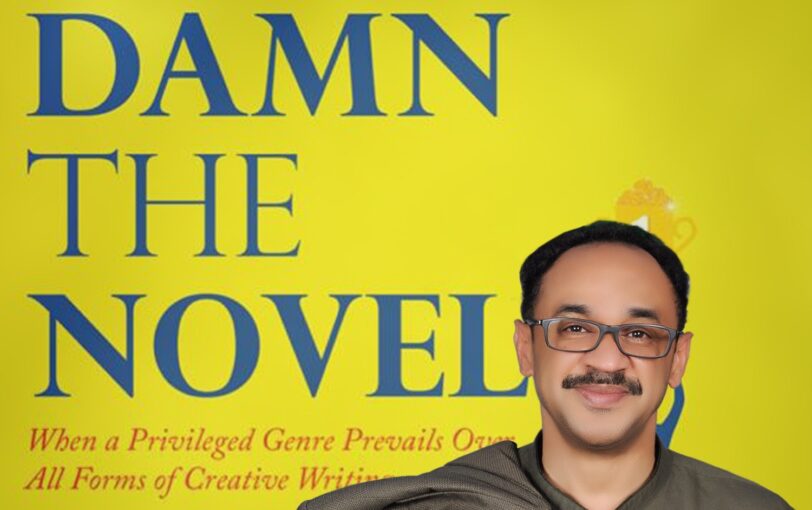
In a series of forty-five short essays that constitute his book translated into English under the title “Damn the Novel: When a Privileged Genre Prevails Over All Forms of Creative Writing,” Sudanese-born poet and essayist Amr Muneer Dahab denounces the privilege granted to the novel, the literary genre that is treated by publishers—and viewed by the public—as superior to all others and is virtually guaranteed marketability and profitability, to the detriment of others.
In this series of posts, the prolific author shares excerpts from the book.

This week: Chapter 41
Mass Media Standards
Writers get very cheerful when they take part in cultural festivities, such as book fairs. Apart from prominent names, writers don’t dare to walk proudly in the book fair probably because they are suspicious about the intervening parties in the great meeting. It’s supposed to be a place for hunting new opportunities. They walk in shame, fearful and suspicious about the publishers and the media alike.
Doesn’t the writer seem to be a bridegroom who is not celebrated in his wedding as he’s supposed to be? This is a question that cannot be answered negatively except for the stars of literature, who are not in need of a collective wedding/ceremony such as a book fair. Every one of them (stars of literature) goes proudly to all events he is invited to, and he gets worried only when he sees another star getting in his way. However, that is much easier than what a humble (non-star) writer experiences, as absolute ignorance is worse than stardom competition.
When literature has its own stardom and stars, it is a matter that should be welcomed with much joy and pride for every writer in this time, even those who are unknown. This may create a sense of hope in every newcomer to the arena of literature hoping to make great career as a writer. The problem lies in the way cultural media deal with the establishment of stars similar to that deployed by the advertisement industry. Creative writing, according to its job description, needs more skills and insight when it comes to determining the shape of the stardom of that writer or other. Maybe we were deceived by the fact that stardom takes importance only from the bright superficial side rather than the heart of it. This does not mean every star lacks depth; it’s just that the bright is given much importance and more opportunities for appearance in the different prestigious festivities and cultural meetings.
So that’s the way the media approach the categorization of every writer. Sebastian Junger said in Why We Write, “Media do this weird thing, if they decided that they liked you. They will create for you a surreal image that no one can reach. I am five feet and three inches, but when I met people they said: we thought you were six feet and six inches. What’s in my book that made me look tall? If you have an amount of insecurity, that might give you more. That leads me to a more self-check. I was shrinking, I was depressed and my situation never changed to the better.”
The critical point being not mentioned by Junger is what media would do if they don’t like you? I will not mention the media measures being implemented on those who are out of the circle. I will just settle for the efficient weapon being used: ignorance. A known publisher told me once, how could it be wise not to make a media critic angry at you? Because he might turn a famous book in the market to something useless.
Sebastian Junger added in the same context: “If you are on the list of ranking of the Times, this is part of your job. There are wonderful books which never appeared in ranking while there are books full of stupid things being in the lucky list. Every writer knows that getting in the list is not related to the quality of the product at all.”
Media figures of course will not remain silent about this accusation. The best answer they can provide is that the reader is the one who has the last word, whereas reality contradicts such statements. Media figures are the one who hold the list of what readers would choose and they are the ones who propose something that is already tested. There is also the cultural crime that media figures commit especially by surrendering to the power of the market and following the steps of their fellows in the advertisement industry.
In an interview from 1990 included in the book entitled Questions of Criticism, Jihad Fadel says in relation to our subject matter: “Octavio Bath, the famous Mexican poet, remained silent once when he visited Paris. He found that the voices of critics are much more than the voices of creators.” Jabra Ibrahim Jabra replied, “that happens even in the forums of novels and novellas. You may not find writers, rather you find more critics making use of the glittering side of the media. I think that is normal because critics produce something that goes with the wave of media. Media can transmit the opinion of critic but cannot transmit the story of a writer, since the writer’s job is to provide you with the whole story, whereas critics have power and dominance. They don’t feel shame to express their opinions and critical stands, they may be harsh enough and their statements may create uproar. In this context, media tend to shed more light on the mission of critics who ultimately turn out to be the stars of the literary/cultural scenes rather than writers (the real producers of literary activity).”
What Jabra considered to be a normal thing doesn’t seem like it is. If critics were once under the light of media a quarter of century ago, then lights are shined these days on the novelists specifically, to the extent that some critics are trying to become novelists in order to get a piece of the pie that novelists are already devouring.
The main point in Jabra’s statement is that the basics by which the media operates are not objective. Mass media is concerned with the bright and media outlets are concerned with what they want to defuse, not what must be transmitted. Jabra states in this context that “many critics do not feel shame expressing what they see . . . and there are critics who might be aggressive that their opinion may create uproar that will attract the attention of media to transmit such opinions to the readers.” Let us have a look at the key words: “shame,” “aggressiveness,” “uproar,” which means that anyone who is “shy,” “modest,” “peaceful,” no matter his/her artistic value, shall receive no other answer from the media than: “Absolute ignorance.”


Soumanou Salifou (administrator)
Soumanou is the Founder, Publisher, and CEO of The African Maganize, which is available both in print and online. Pick up a copy today!