

DRC and Rwanda presidents seal peace accord in US
BY JIBRIL TURE
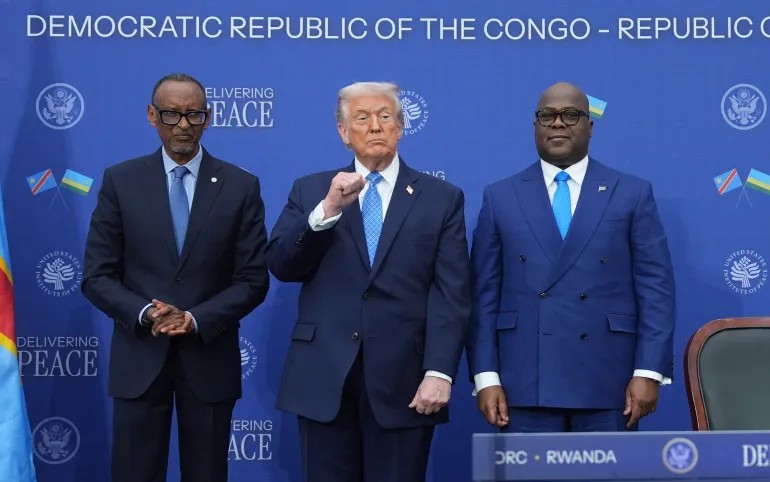
The presidents of the Democratic Republic of Congo and Rwanda a few hours ago sealed the so-called Washington Accord signed last June in Washington by their respective foreign ministers aimed at ending the war between the two countries for control of DRC’s mineral resources. The high-profile signing took place in the U.S. Institute of Peace (USIP) building, which was renamed yesterday, Wednesday, after Donald Trump—yet another sign of Trump’s desperate pursuit of the title of world global peace maker.
The peace deal signed by the two heads of state alongside their American counterpart who showered them with praise, calls for a permanent ceasefire with disarmament protocols and laid a pathway to economic integration. Trump described the agreement as a “historic success,” noting the failure of several past administrations to end the conflict. In fact, the conflict broke out as recently as 2022 after Rwandan forces crossed into DRC’s territory to support the March 23 Movement rebel group, best known by its acronym M23, fighting alongside them against the Congolese military, (FARDC).
The previous signing of the peace deal by DRC’s and Rwanda’s foreign ministers in June did not hold its promise. In fact, earlier today, while the momentum was building up for the signing ceremony, fighting flared up on the field, causing international observers to speak of a “a fragile peace deal.”
Several African leaders witnessed the signing ceremony in person, including the President of Angola, João Lourenço, his counterparts from Burundi and Kenya, Évariste Ndayishimiye and William Ruto, not to mention the prime minister of Togo, Faure Gnassingbé, the vice president of Uganda, Jessica Alupo, and the African Union Commission’s chairperson, Mahamoud Ali Youssouf of Djibouti.
Both DRC’s president, Félix Tshisekedi and his Rwandan counterpart, Paul Kagame, are mindful of the high stakes of the agreement. “If things do not unfold as planned, the responsibility will not lie with President Trump. We will be responsible,” said Paul Kagame whose words must have sounded like music to Trump’s ears when he pointed out the praise-thirsty U.S. president’s “fair and pragmatic approach.” Kagame stated his country’s commitment to regional security and stability.
For his part, the Congolese head of state, Félix Tshisekedi, hailed the agreement as a “historic turning point” for the Great Lakes region, stating his commitment to its implementation with “seriousness, rigor, and a constant focus on peace and the unity of the territory.” He pledged to implement the framework with “seriousness, rigor, and a constant focus on peace and the unity of the territory.” He pleaded his Rwandan counterpart to do the same, especially ending Rwanda’s support for the armed group.
“Nations don’t have allies, they have interests,” is a well-known phrase in international relations. Trump’s breakneck pursuit of the Nobel Peace Prize—while, paradoxically, threatening to invade Venezuela—is no doubt part of his effort to end the conflict between the neighboring nations of DRC and Rwanda. U.S. economic interests are the other component.
Trump said the United States was signing today its own minerals agreement with both Central African nations today, adding that it “will “unlock new opportunities for the United States to access critical minerals and provide economic benefits for everybody.” He pledged the United States will send some of its “biggest and greatest companies” to the area: “Everybody is going to make a lot of money.”


Soumanou Salifou (administrator)
Soumanou is the Founder, Publisher, and CEO of The African Maganize, which is available both in print and online. Pick up a copy today!