

Why U.S. hostility toward Russia’s African ally Burkina Faso
By Fofana Abdoulaye Sidibe
The uproar ignited on April 3 by the commander of U.S. Africa Command (AFRICOM), General Michael Langley, during a Senate hearing, accusing the president of Burkina Faso, Captain Ibrahim Traore, of corruption further pushed the Burkinabe head of state into the arms of Russian President Vladimir Putin, while deepening anti-Western sentiments in the African region, especially against the United States. Under normal circumstances, a loss of ground by the United States in favor of Russia is a matter of concern for Washington, but these are no normal times, with a chaos-driven, unsophisticated U.S. president whose administration has voted twice with Russia and North Korea at the United Nations.
AFRICOM is the Pentagon’s regional command for Africa responsible for coordinating U.S. military operations, intelligence gathering, and security partnerships across the continent, a set of activities that is often framed as counterterrorism operations. During the afore-mentioned hearing before the Senate Armed Services Committee, the AFRICOM commander did not mince his words when asked by committee chairman Roger Wicker about corruption as related to Burkina Faso’s trade with China: “Chairman. I see this, and I don’t mind calling it out. Captain [Ibrahim] Traore in Burkina Faso… their gold reserves are just in exchange to protect the junta regime.”
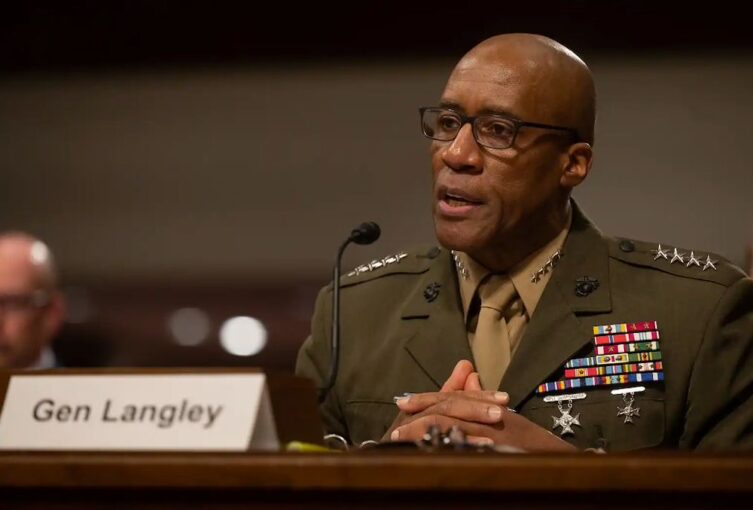
The statement triggered outrage across Africa. Captain Traore demanded an apology from Gen. Langley who, instead of an apology, doubled down. “It is an insult asking me to apologize to Ibrahim. I am a four-star General of United States Marines protecting the interests of American Government. He is brain-washing the African people, and he has to stop.”
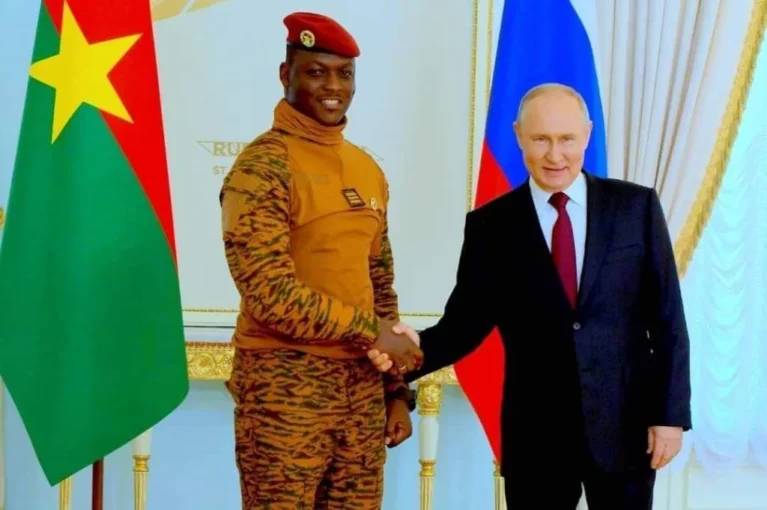
The general’s tough words may have served his own ego and sounded nice to the ears of members of the Senate Armed Services Committee, but they didn’t stop the Burkinabe president from going on a pre-planned trip to Russia, arriving in Moscow on May 8, 2025, to attend the Victory Day Parade on May 9th. During this visit—his second one since the 2023 Russia-Africa Summit, the 37-year-old West African head of state received an exceptionally warm welcome from his host, including a tete-a-tete meeting with Putin that, no doubt, strengthened the ties between the two nations. Throughout the events marking the commemoration, the young captain dominated the room from the height of his 6.2 ft, with his intimidating strong build and in full gear, alongside China’s premier, Xi Jinping, and a few other African heads of state.
In an interview with Russian state-controlled television station RT about General Langley’s criticism of him, Captain Traore stated the obvious: “First of all, it’s Burkina Faso’s gold. It’s not his gold.” He also asked rhetorically, “What is his business?”
It is not the business of the commander of AFRICOM to decide how the Burkinabe authorities should use their gold. His responsibility as, indeed, he stated earlier, is to protect “the interests of American Government.”
Not unlike other nations, trade and investment are among U.S. biggest interests in its relations with the rest of the world. Despite Burkina Faso being the fourth world producer of gold, trade between the West African nation and the United States is negligeable. According to the Office of the U.S. Trade Representative, USTR:
U.S. total goods trade with Burkina Faso were $58.9 million in 2024. U.S. goods exports to Burkina Faso in 2024 were $54.4 million, up 17.7 percent ($8.2 million) from 2023. U.S. goods imports from Burkina Faso in 2024 were $4.5 million, up 11.4 percent ($0.5 million) from 2023. The U.S. goods trade surplus with Burkina Faso was $49.8 million in 2024, a 18.3 percent increase ($7.7 million) over 2023.
These are anemic numbers compared to the trade relationship between, say, Cote d’Ivoire, for which the USTR data is:
U.S. total goods trade with Côte d’Ivoire were $1.6 billion in 2024. U.S. goods exports to Côte d’Ivoire in 2024 were $596.6 million, up 15.6 percent ($80.4 million) from 2023. U.S. goods imports from Cote d’Ivoire in 2024 were $1.0 billion, up 7.0 percent ($66.7 million) from 2023. The U.S. goods trade deficit with the Côte d’Ivoire was $418.1 million in 2024, a 3.2 percent decrease ($13.7 million) over 2023.
Trade relations between Russia and Burkina Faso are even smaller, quasi non-existent. According to the Organization for Economic Co-operation and Development, OECD, in January 2022, Russia exported $1.04M and imported $23k from Burkina Faso, resulting in a positive trade balance of $1.02M. But that is about the change drastically, owing to the developing relations between the two countries, which recently birthed several cooperation agreements.
Following a tete-a-tete meeting with Putin on May 11, Traore said to the Russian media that not only did he want his country’ relations with Russia to grow “exponentially,” but he also wanted them to expand into new areas. “We have a lot of work ahead of us,” he said, pointing out technological support as one key area. For his part, Putin said in reference to the weak trade relations between the two nations, “It is still increasing, and this is a good trend. We need to work together to further strengthen economic ties and diversify mutual trade.”
On April 25—that is even before Traore’s visit to Moscow—Burkina Faso granted a mining lease to Russia’s Nordgold for a gold project.
Such developments, clearly, don’t serve the U.S. interests General Langley said it is his mission to protect.
Despite the importance of trade in its foreign relations, when it comes to Burkina Faso and other nations in the Sahel region, the United States is more preoccupied with the ability to pre-empt and foil possible jihadist attacks on U.S. soil, as such attacks usually come from that region. The motto is well-known: “Let’s stop them there before they come here.” To achieve this goal, Washington needs reliable allies in the epicenter of jihadist violence that is the Sahel region.
That explains the all-out effort on the part of the West, especially the United States and France, to restore Nigerien president, Mohamed Bazoum, when he was removed from power on July 26, 2023. Having strong economic interests on top of the security one, France was reportedly in favor of using force to restore the deposed president, but apparently the Biden administration preferred diplomacy and soft power.
The rebellion of Burkina Faso, Mali, and Niger against their former colonizer, France, following a military coup in all three countries, going as far as creating their own regional organization, the Alliance des Etats du Sahel (the Alliance of Sahelian States, AES), ushered in a new geopolitical dynamics. The three nations even plan on creating their own currency, consistently with their determination to take their destiny in their own hands, independent of traditional Western influences.
The populations in the region and beyond welcomed the change and adore the new leaders. Captain Ibrahim Traore, especially, is the subject of literal adulation. The elites and the masses across most of the continent took the Internet by storm to condemn Langley for criticizing the charismatic 37-year-old head of state. Additionally, massive demonstrations of support were held in several African cities, not to mention the gathering of thousands of Burkinabe citizens that took part in a massive demonstration in Ouagadougou, Burkina Fasso’s capital, in the wake of the alleged foiled coup to topple Traore and his government.
Because of the captain’s Pan-Africanist vision and nationalistic views, many liken him to one of the continent’s heroes, his late fellow-Burkinabe, Thomas Sankara, who was assassinated at blank point in 1987 by his best friend who took his position, but allegedly at the instigation of Western leaders who did not appreciate Sankara’s revolutionary rhetoric and, indeed, his politics.
Captain Traore’s government said on April 22 that it had foiled a coup that was planned on April 16 to overthrow the government. The authorities pointed an accusatory finger at Burkina Faso’s neighbor down south, Côte d’Ivoire.
Burkina’s embrace of Russia raises several questions that only time can answer. Probably the biggest one is, what is the likely outcome of Burkina Faso’s relations with Russia? The history of the Wagner Group, a Russian government-funded private military—by definition connected to Putin—has a history of extracting African countries’ mineral resources on the cheap against protecting the leaders who get a kick-back, and not much beyond that. While Russia does provide some aid to African countries, it does so in amounts ridiculously smaller than the United States and the European Union. The question then becomes, will the smart, young officer who grabbed power in September 2022, driven by patriotism but under pressure from the West and its African allies, be able to deal as an equal with a cunning old-timer Putin and get a fair deal from an economically weakened Russia stretched thin by a protracted war in Ukraine that it cannot win?
In the aftermath of Niger’s decision to withdraw from its military cooperation with the United States in 2024, Omar Arouna, former Ambassador of Benin to the United States and President of Global Public Affairs and Engagement at Gunster Strategies Worldwide, wrote for The African a paper titled A Comprehensive Analysis of Niger’s Withdrawal from Military Cooperation and Its Geopolitical Implications. The sharp analysis focuses on the need to explore, using the author’s own words, “the historical context, implications, and potential solutions for this development, which has far-reaching consequences for regional stability and U.S. foreign policy.”
“In moving forward, it is essential for the U.S. to adapt to the changing dynamics of West Africa and cultivate authentic partnerships rooted in mutual respect, shared values, and a thorough understanding of the region’s cultural and geopolitical complexities,” the veteran ambassador writes. “Prioritizing diplomatic initiatives, strengthening regional collaboration, and focusing on soft power approaches that foster long-term development are key to repositioning the U.S. as a reliable and constructive ally in West Africa.”
General Langley’s disparaging words for Traore, especially after the outrage triggered by his remarks when he was asked by the Burkinabe leader to apologize, don’t qualify as diplomatic.
President Trump’s chaotic, unsophisticated style has no room for soft power, as he demonstrated with his suspension of aid to Africa the first week of his return to the White House. One could argue, based on the flagrant racism he displayed by ambushing South Africa’s president, Cyril Ramaphosa, at the White House on May 21 with unfounded allegations of genocide, that he has no appetite for dealing constructively with Africa. Even if he did, he would not have the courage to displease the Russian strongman whose support he sought, on live television, to release emails that proved damaging to his more qualified opponent during the 2016 presidential campaign.
Fast-forward to his current term, after Trump himself egregiously blamed Ukraine for the war started by Putin by invading his neighbor, the Trump administration on February 25 went down on a path rarely traveled by the United States by voting with Russia, North Korea, and Belarus against its European allies on a resolution urging Russia’s withdrawal from Ukraine.
In sum, Russia’s foreign policy has a bright future in Africa—for better or worse for Africans.


Soumanou Salifou (administrator)
Soumanou is the Founder, Publisher, and CEO of The African Maganize, which is available both in print and online. Pick up a copy today!